A building product touches people and the planet in five broad ways: the health of the people who live and work with it, the climate, how materials are used and reused, the people who make it, and the nature its materials come from. Labels don't all look at all five. In the Klar Cite map, 59 of the 109 labels a construction product can carry reach all five areas with at least one requirement, and the rest reach fewer, often by design.
What's more useful to know is how a label checks each area, because there are only a handful of common approaches.
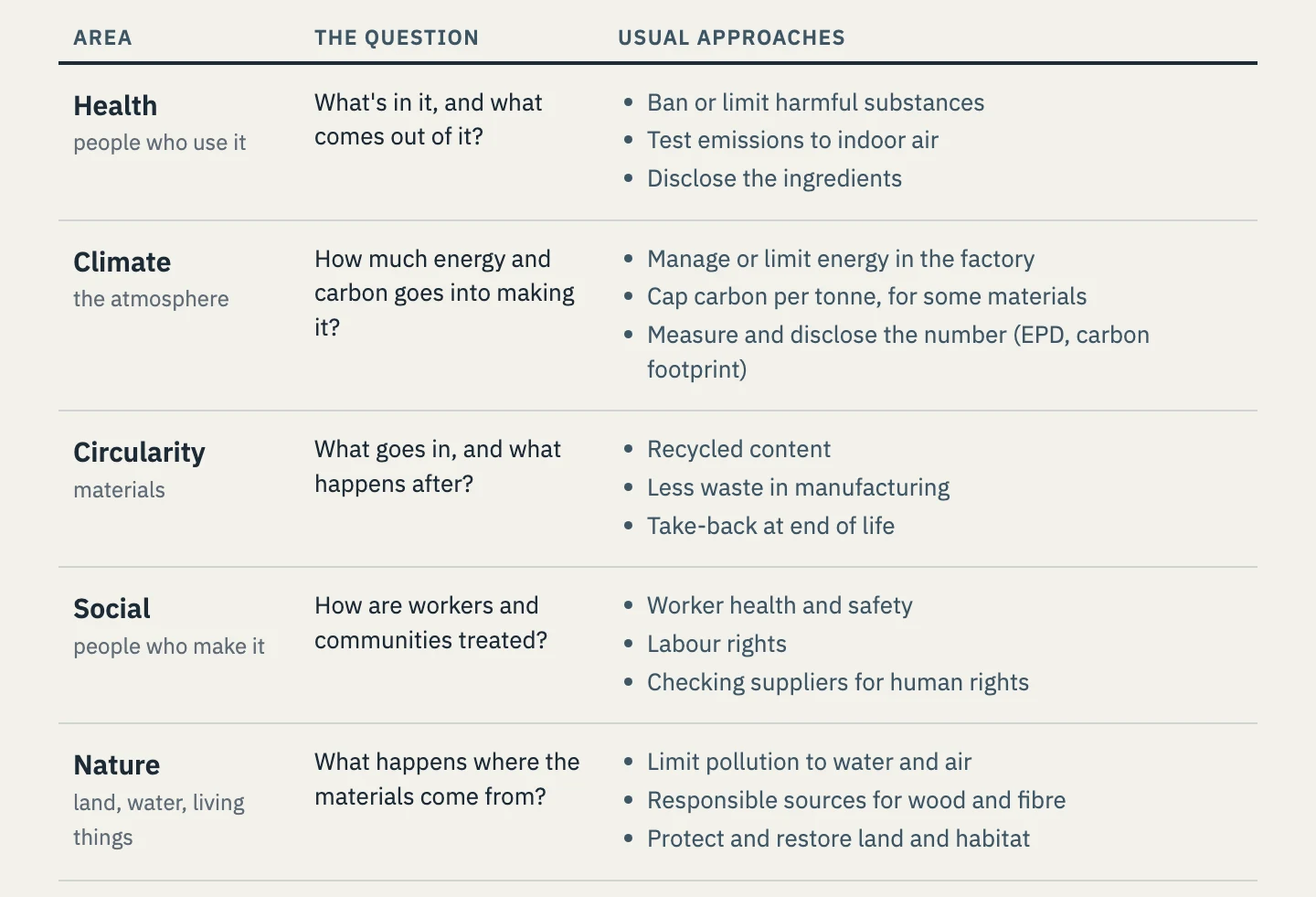
Health: what's in it, and what comes out of it
Most labels say something about health. Of the 110 labels I looked at for builders' questions, 84 set at least one requirement on hazardous substances (What builders ask). The usual approaches are:
- Ban or limit harmful substances in the product, such as lead, cadmium or certain phthalates.
- Test what the product releases into indoor air, usually in a test chamber, against limits for VOCs and formaldehyde.
- Disclose the ingredients, often screened against lists of chemicals of concern, and leave the judgement to you.
The same substance can be treated quite differently. On one carpet, one label can ban phthalates, another cap them, and a third list them for regular review (Behind the Logo).
Climate: energy, carbon and the number itself
Labels mostly address climate indirectly, through how a product is made. Of 58 ecolabel criteria documents, 34 set rules on energy in manufacturing, such as an energy plan, a limit or a share of renewable power, and only 6 ask for the carbon number itself (Behind the Logo). The usual approaches are:
- Manage or limit energy use in the factory.
- For some materials, cap the carbon emitted per tonne made, such as for cement, steel or aluminium.
- Measure and disclose the number, through an EPD or a product carbon footprint.
If you are asked for embodied carbon, the number usually comes from a declaration rather than an ecolabel (Beyond the EPD).
Circularity: what goes in, and what happens after
At least 83 of 110 labels set a circularity requirement (Circularity). The most common approaches are:
- Recycled content: a minimum share, from 5% to 100%, set on different parts of the product.
- Less waste in manufacturing.
- Take-back: the manufacturer takes the product back at the end of its life.
Fewer labels ask about durability and repair, or about whether a product can be taken apart, though these matter as much for keeping materials in use.
Social: the people who make it
At least 68 of 110 labels set a social requirement (Who made it). The most common approaches are:
- Worker health and safety at the factory, forest or mine.
- Labour rights: no forced or child labour, freedom of association, no discrimination.
- Checking suppliers, through due diligence on human rights.
The depth sits with the labels that certify where materials are made, such as forests, steelworks and concrete plants, which set tens of social requirements each. Most product ecolabels set one or a few. Of the 68, 47 have at least one requirement that reaches beyond the certified site to suppliers or raw materials.
Nature: the land, water and living things affected
At least 84 of 109 labels set a nature requirement (Nature). The most common approaches are:
- Limit pollution: discharges to water, emissions to air, harmful chemicals.
- Control where materials come from: responsibly managed forests, or certified or legal sources for wood and fibre.
- Protect land and habitat: no clearing of natural habitat, biodiversity plans, restoring quarries and mines.
Pollution comes up most often (64 labels). Land and habitat, the biggest driver of nature loss on land according to IPBES, comes up less often (at least 35). Nearly all the labels that certify forests, steelworks, aluminium operations and concrete plants address it (14 of 15), but only about one in five product ecolabels do (17 of 76).
What this means when you choose
A label that reaches all five areas isn't automatically the right one, and a label that reaches one isn't a lesser one. A low-emission certification for flooring goes deep on health and says little else, which may be exactly what a project needs. A broad ecolabel covers more ground, sometimes with only one or two requirements in an area.
So when you look at a label, ask which of the five areas matter most for this product, and then how the label checks them: a ban, a test, a limit or a disclosure.
Next in the series: how green building rating tools recognise labels.
Klar Cite register. The 59 of 109 is as recorded in build 2026-10-22-0117, counting an area where any of a label's requirements is assessed to it, which shows reach, not depth. The other counts are from the articles linked, each on the build stated there. The map held 110 labels for construction products on the earlier builds and 109 on build 2026-10-22-0117. Textile standards are included. The five areas follow mindful MATERIALS' Common Materials Framework (CMF), in plain-language names. A requirement count is not a measure of rigour.