Among the specifiers I surveyed this year who want a label on top of an EPD, 62% want it to cover ethical sourcing, and 45% of the manufacturers say the area gets too little attention (survey write-up). Carbon has the EPD, and circularity and material health have plenty of criteria to argue about. The conditions under which a product and its materials were made are harder to see from a logo, and harder to check.
By label I mean anything that shows what a product, or a forest, mine, plant or company in its supply chain, meets or discloses: ecolabels, environmental product declarations (EPDs), product carbon footprints, other declarations, and certifications of the forests, plants and companies that materials come from or pass through, such as forest management, steelworks and chain-of-custody certificates. Some are certifications, checked against requirements that must be met. Others are declarations, which report information without a pass mark. The map holds 110 labels that apply to construction products, each set out in a published standard or set of criteria.
What I mean by social
There is no settled definition. One study of the concept finds no consensus on how to define social sustainability (de Fine Licht and Folland 2019), and social life cycle assessment, the closest thing to a method for products, has no ISO standard and gives results that are hard to compare (Mármol et al. 2023). Two reference points recur across the standards. The first is the ILO's fundamental principles and rights at work: freedom of association, no forced labour, no child labour, no discrimination and, since 2022, a safe and healthy working environment (ILO). The second is the UN Guiding Principles on Business and Human Rights, which ask companies to carry out human rights due diligence and to give affected people a way to raise grievances (UN Guiding Principles).
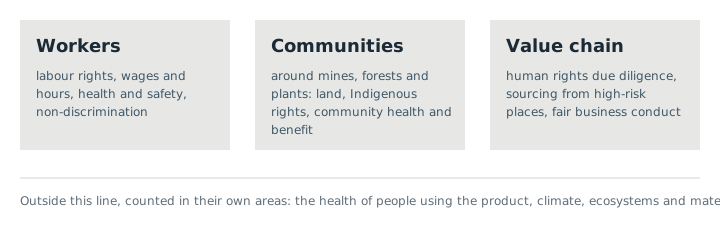
The map calls this area social health and equity, following mindful MATERIALS' Common Materials Framework (CMF), which doesn't spell out the area's content on its public pages (mindful MATERIALS). So the line is my own, drawing on these sources. Social, here, means the people a product's making touches: the workers who make it and its materials, the communities around the mines, forests and plants, and the wider value chain. Klar Cite sorts requirements into five areas: human health, climate, ecosystems, circularity, and social health and equity. Human health is about the people exposed to the product itself, through what it contains and what it emits into a room. Social health and equity is about the people who make it and live around where it is made. A limit on formaldehyde emitted by a finished panel counts as human health; a limit on workers' exposure to formaldehyde in the factory counts as social.
What they ask about
At least 68 of the 110 labels in the map set one or more social requirements, and every one of the 68 is a certification. Sorted by what they ask about, the picture is clear enough.
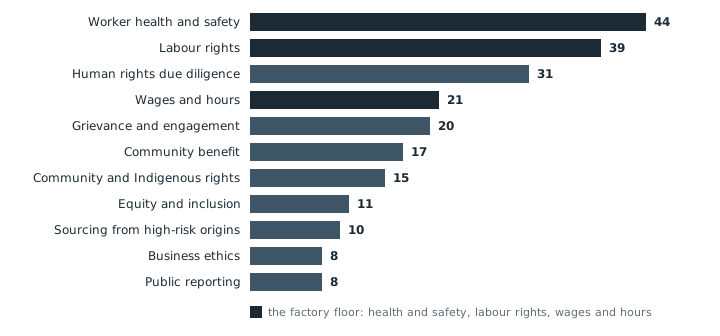
Worker health and safety comes first, set by 44 labels, followed by labour rights such as forced and child labour, freedom of association and non-discrimination (39), and human rights due diligence and supplier assessment (31). Wages and working hours (21) and grievance and engagement (20) come next. Community benefit (17), community and Indigenous rights (15), equity and inclusion (11), sourcing from high-risk origins (10), business ethics (8) and public reporting (8) are rarer.
The factory floor comes first, in other words. That makes sense to me, because a site's safety record and its employment terms can be audited on the day, and the conditions at a mine three suppliers back cannot. The way requirements are framed points the same way: 52 labels set a qualitative obligation and 44 a policy or plan, 30 rest at least in part on complying with the law, and 12 set an outright ban. A requirement to comply with the law matters most where the law is weakly enforced, and adds less where it already is.
Where they sit
Most of the depth sits where materials are made. To hold most labels that certify a forest, a steelworks, an aluminium operation or a concrete plant, a producer is assessed against tens of social requirements (a median of 43 per label). Ecolabels and other product certifications ask for few: a median of one, and most of those that ask for any set between one and eight. Declarations, EPDs included, ask for almost none. Ecolabels cover many areas at once, and their social requirements are often a commitment or policy, compliance with the law, or a single workplace measure such as an exposure limit, rather than a full set of workplace rules. So a product can rely on social requirements met further up its supply chain. Timber is the clearest case: the chain-of-custody label that follows the wood asks for fewer social requirements than the forest certification does, but it traces certified wood back to forests assessed against requirements on the rights of local communities, Indigenous peoples and workers (mixed products can also contain other controlled and recycled wood).
A requirement count is not a measure of rigour. A standard for a site is written requirement by requirement, while an ecolabel can cover the same ground in one sentence that points to the law.
How far back it looks
For a specifier, the most useful question may be how far back a label looks. Of the 68 labels with social requirements, 47 have at least one that reaches suppliers or the sources of raw materials. The other 21 have none that I read as reaching beyond their own site.
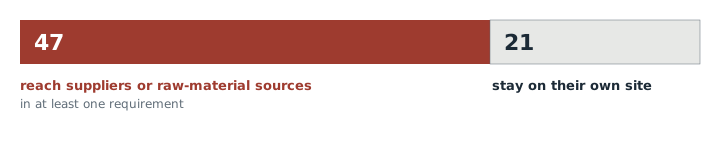
Reaching back can mean a supplier code of conduct, due diligence across the supply chain, or a ban on material from places where rights are abused, and these are quite different promises. Staying on site matters less than it sounds for some labels, because for a forest, mine or plant the certified site is where the material comes from.
Drawing the line at the site gate isn't unique to labels. The ILO's code of practice on safety and health in the iron and steel industry covers the steelworks and leaves out the mining of the raw materials (ILO code of practice).
One product: steel
Steel shows why the question matters. The US Department of Labor's 2024 list of goods produced with child or forced labour has no entry for iron ore or pig iron, but it lists coal from several countries and charcoal from Brazil (US Department of Labor), and charcoal is one of the fuels used to make pig iron in Brazil (Ramos et al. 2019). Where the list records a risk, it sits several steps before the mill.
Green Star's Responsible Products list recognises six steel-related labels that Klar Cite holds, of four types: a certification for steelmaking sites, a responsible sourcing certification, an Australian certification for steel producers and processors, and ecolabel criteria for steel products from two schemes.
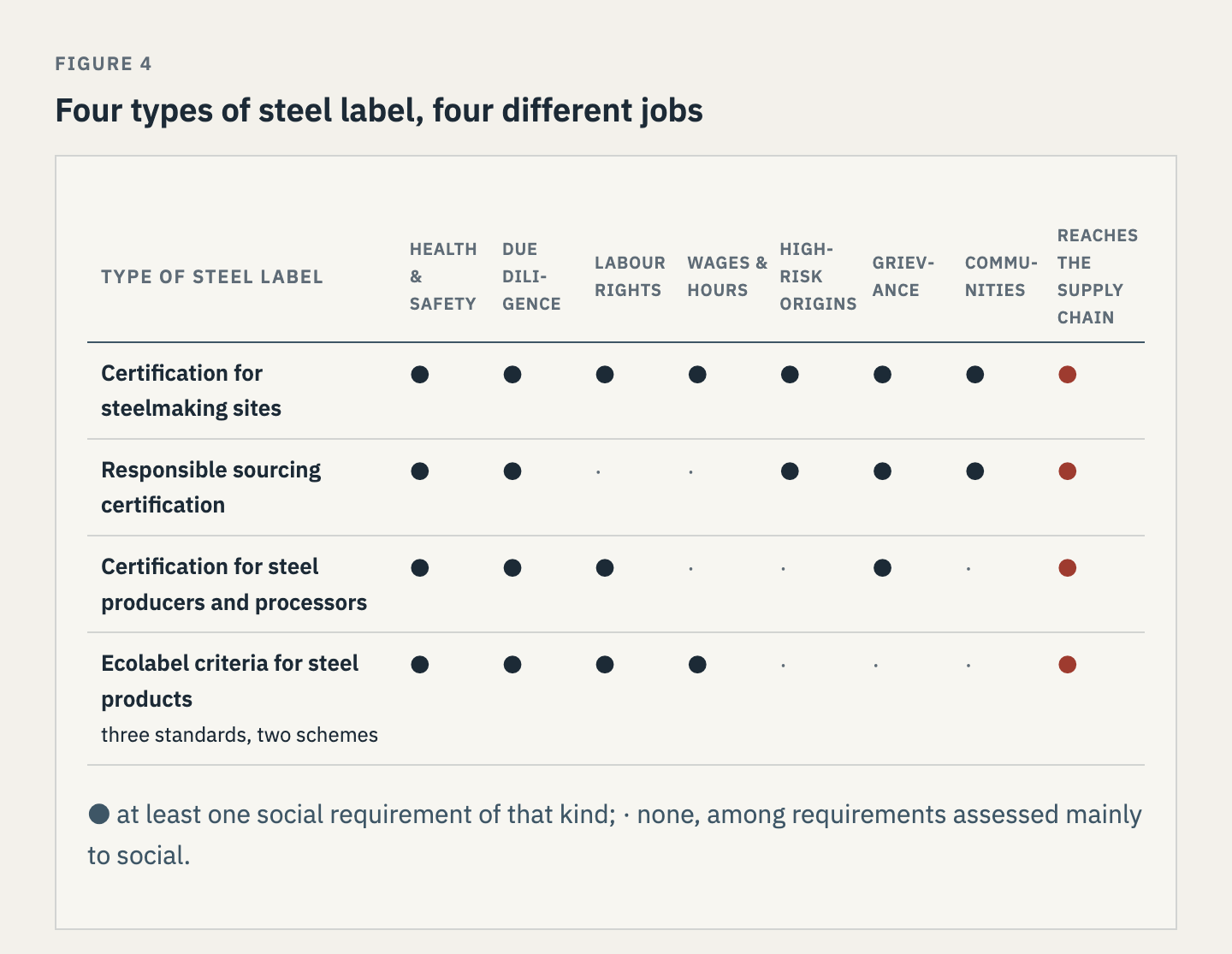
Each of the four types includes requirements on health and safety and on due diligence or modern slavery, and each has at least one requirement that reaches beyond the producer's own site. Beyond that they do different jobs. The site certification covers the widest range, from wages and hours to local communities, and its sourcing requirements reach back to suppliers and scrap. The ecolabel criteria certify a steel product across several areas, and their social requirements are a short set: a human rights or modern slavery commitment, compliance with the law on wages, equal opportunity and safety, and corrective action where modern slavery is found.
None of this says one label is better than another. A specifier asking for "responsibly sourced steel" can be offered any of these, and each answers a different question about who made it.
Rating tools, in passing
Rating tools approach social conditions in their own ways, and they decide what counts towards a building's rating rather than what a product must meet to be certified, so I keep them apart from these counts.
Green Star's Responsible Products program lists products that "respect human rights" among its aims (GBCA), and in the register its guidelines give credit for manufacturer-level criteria such as a certified health and safety system, modern slavery due diligence, and free, prior and informed consent before new extraction. The Living Building Challenge, run by the International Living Future Institute, has an Equity Petal for "a just and equitable world" (Living Building Challenge). Its Inclusion imperative asks for the Institute's JUST label, a disclosure label for organisations, on some of the organisations in the project team, and its sourcing imperatives support a regional economy and ask project teams to advocate for fair labour standards in stone and metal extraction. That puts the social focus on the project and the people building it, more than on the products. WELL added a beta feature in late 2024, Fair Labor in Building Products, which asks for products from manufacturers that verify fair labour practices at their own facilities and across their supply chains (IWBI). Like Green Star's criteria, it looks at the people behind the products, here at the scale of a building.
Choosing by who you want covered
If there is one practical takeaway, it is to decide whose conditions you want covered before reading the logo. If it is the people in the factory, most labels with social requirements say something about health, safety and employment terms. If it is the supply chain, look for due diligence and sourcing requirements that name suppliers or origins. If it is the forest, mine or plant where the material starts, look for the label that certifies that site, or a chain of custody that traces certified material back to one.
With Klar Cite, "responsibly sourced" on a logo becomes the requirements behind it, where the scheme allows them to be shown, so you can check how far back a label looks before you open the standard.
How far back do you look when you specify, and does the label you ask for look as far?
How this was mapped
Klar Cite register, build 2026-10-11-0932, current editions. The broad areas are my judgement from a requirement-by-requirement assessment. Of the 1,675 requirements assessed mainly to social health and equity, 913 were re-read one by one for this piece and sorted by kind and by how far back they reach. Every one was read except those of the two largest schemes, a forest and a concrete scheme, which were sampled (75 each). A blind re-read of a sample agreed on 21 to 23 of 24 calls per question, and a verifier's own sample of 20 held on 19 or 20. Requirements assessed to social only as a secondary area were not re-read, so the counts of labels with social requirements, and of those reaching the supply chain, are a floor; the count staying on site is a ceiling. Medians are per label, counting requirements assessed mainly to social, grouped by what each label certifies. Figure 4 shows, for each type of steel label, what any label of that type asks about. The rating-tool criteria come from the register's demand side and the tools' public pages, and are never counted with label requirements. A label counts once however many of its requirements qualify. Textile standards are included. A count of requirements is not a measure of rigour.
Method and sources: Klar Cite register, build 2026-10-11-0932. Scheme web pages accessed 13 and 14 October 2026. Survey figures from my 2026 specifier and manufacturer surveys.