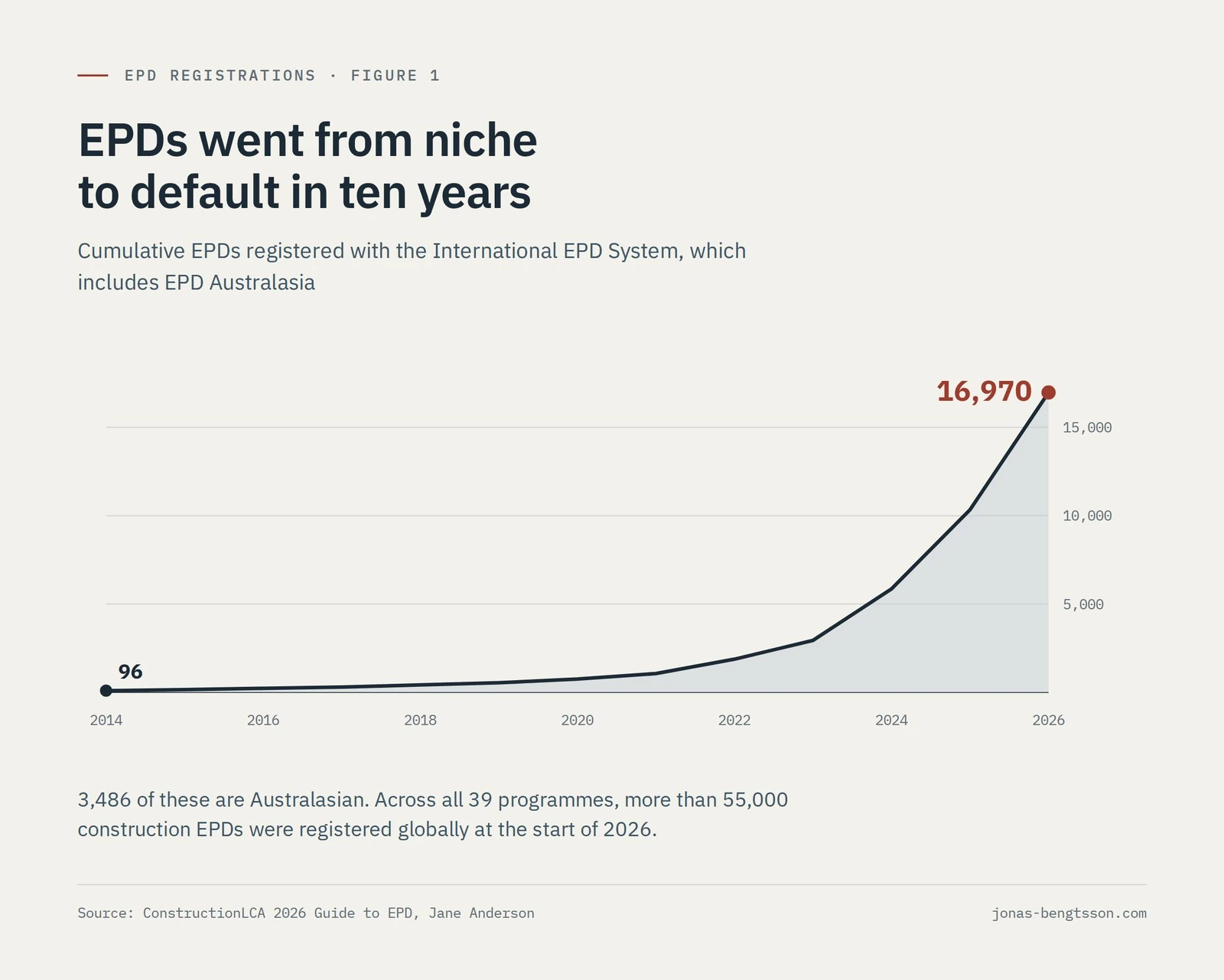
It took EPD Australasia, the programme for Australia and New Zealand, about a decade to publish its first 2,000 EPDs, and just over a year to publish the next 2,000. The 4,000th came in May 2026. The pattern is global. The International EPD System, which EPD Australasia is part of, listed 16,970 EN 15804 EPDs for construction products at the start of 2026, 3,486 of them Australasian. Across all the EPD programmes ConstructionLCA tracks, 57,995 were registered, up from nearly 40,000 a year earlier. The market asked for data, and manufacturers are supplying it.
Data isn't the whole ask
My research this year points the same way, and further. Most specifiers I heard from (85%) need a full EPD by the time a product is specified, and only 6% think a carbon footprint on its own is enough. Half want a certified label on top of the EPD, and those who do name circularity (88%) and ethical sourcing (62%) as what should come after carbon. For flooring and finishes, 70% ask for a health declaration, a label, or carbon and a label together.
So the EPD is the floor, and many projects ask for something on top. From what I see, Green Star's Responsible Product Value has also prompted some manufacturers to look at their credentials as a set, where a combination is valued in its own right. That raises a practical question I wanted to answer from the clauses: what does a second credential actually add, and what does it repeat?
The building blocks
I took interior wall paint, because there is plenty to compare. Klar Cite holds four sets of ecolabel criteria written for interior paint, along with the rules for the declarations a paint maker would consider. In the order they appear below:
- An EPD declares many environmental indicators across the life cycle. It sets no pass mark, and programme operators such as the International EPD System and EPD Australasia require it to be independently verified before publication.
- A product carbon footprint (PCF) to ISO 14067 covers one impact area, climate change, which it may report as several indicators, such as total, fossil and biogenic global warming potential. Under the standard, external verification is optional.
- Declare discloses what is in the product: every intentionally added ingredient and residual at or above 100 ppm. The label shows one of three levels. At LBC Red List Free, everything is disclosed and nothing on the Red List is in the product. At LBC Red List Approved, at least 99% is disclosed and Red List chemicals are allowed only through approved exceptions. At Declared, everything is disclosed, but Red List chemicals may be present. Living Future reviews each label, and independent third-party verification is a separate option. In the comparisons below, Declare means the Red List Free level, and I note where a lower level changes the answer.
- A Type I ecolabel certifies the product against criteria, with a pass mark. What those criteria cover depends on the label. For paint I compared Australian paint criteria, the EU's paint criteria, a German low-emission label and New Zealand's paint criteria.
I then compared the three single options a manufacturer might start with (an EPD, a PCF or an ecolabel) and the four pairs: EPD and Declare, EPD and an ecolabel, PCF and Declare, and PCF and an ecolabel.
Which areas each option reaches
The first angle is breadth. In my judgement, drawing on a clause-by-clause assessment against five broad areas, the building blocks spread like this:
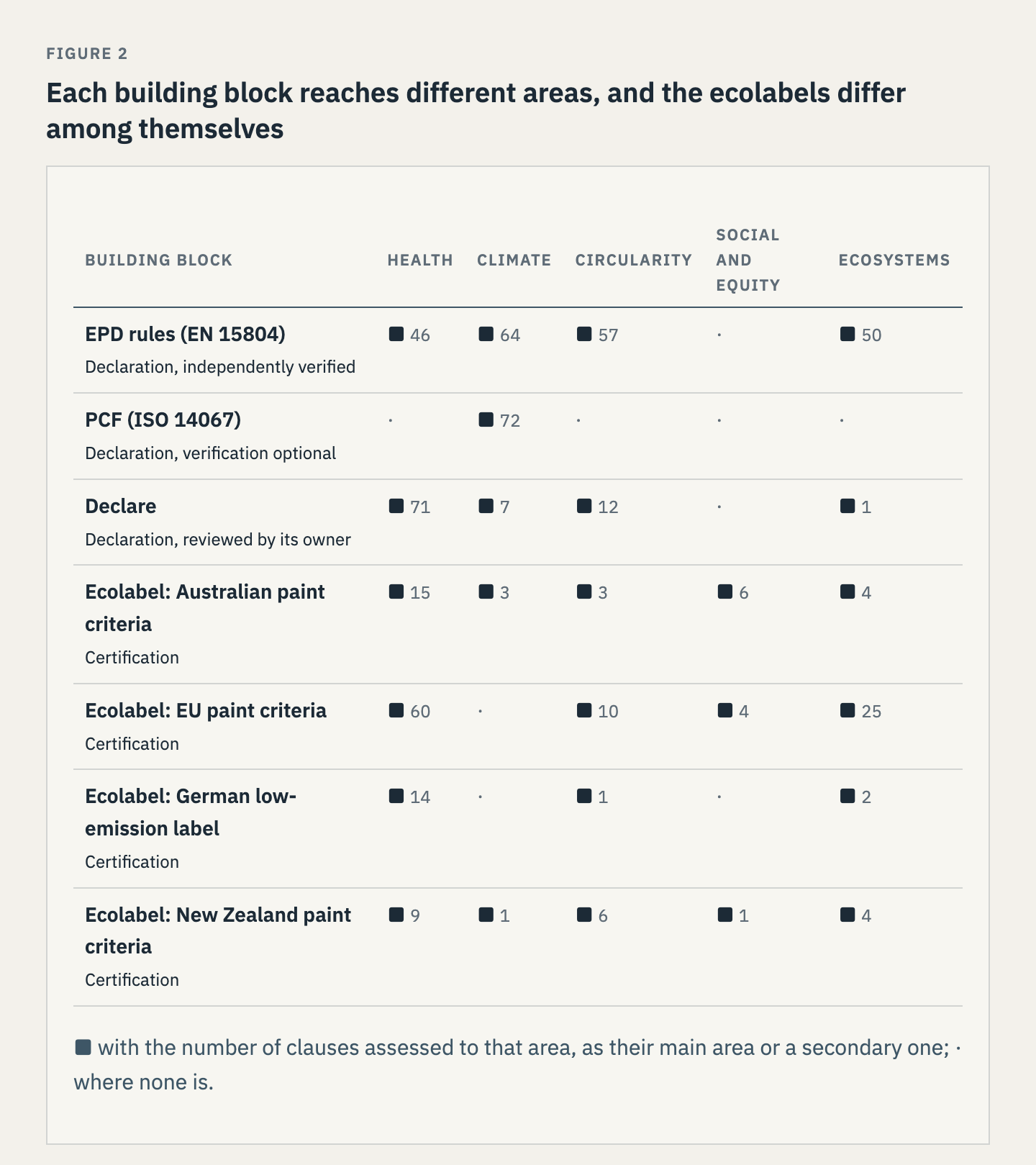
The declarations are each concentrated somewhere different. The EPD rules reach health, climate, circularity and ecosystems through the indicators and information they call for, the PCF standard reaches climate only, and Declare is mostly about health, with a little on climate and circularity. None of the three has a clause on workers, labour or social conduct, as recorded. Declare's owner runs a separate social-equity label for organisations, which this comparison doesn't cover.
The ecolabels differ more among themselves than I expected. The German low-emission label is concentrated on health, while the others reach further into circularity and ecosystems, and three of the four have clauses on workers, from workplace health and safety to modern slavery and human rights. So "an EPD plus an ecolabel" depends on which ecolabel. Adding any of the other three to an EPD reaches all five areas, as I count them, and adding the low-emission label mostly deepens health.
Where they overlap, and how
The second angle is overlap. Two credentials can address the same issue and still tell you different things, because one measures, one discloses, and one sets a limit. Reading the clauses issue by issue gives a clearer picture than counting topics:
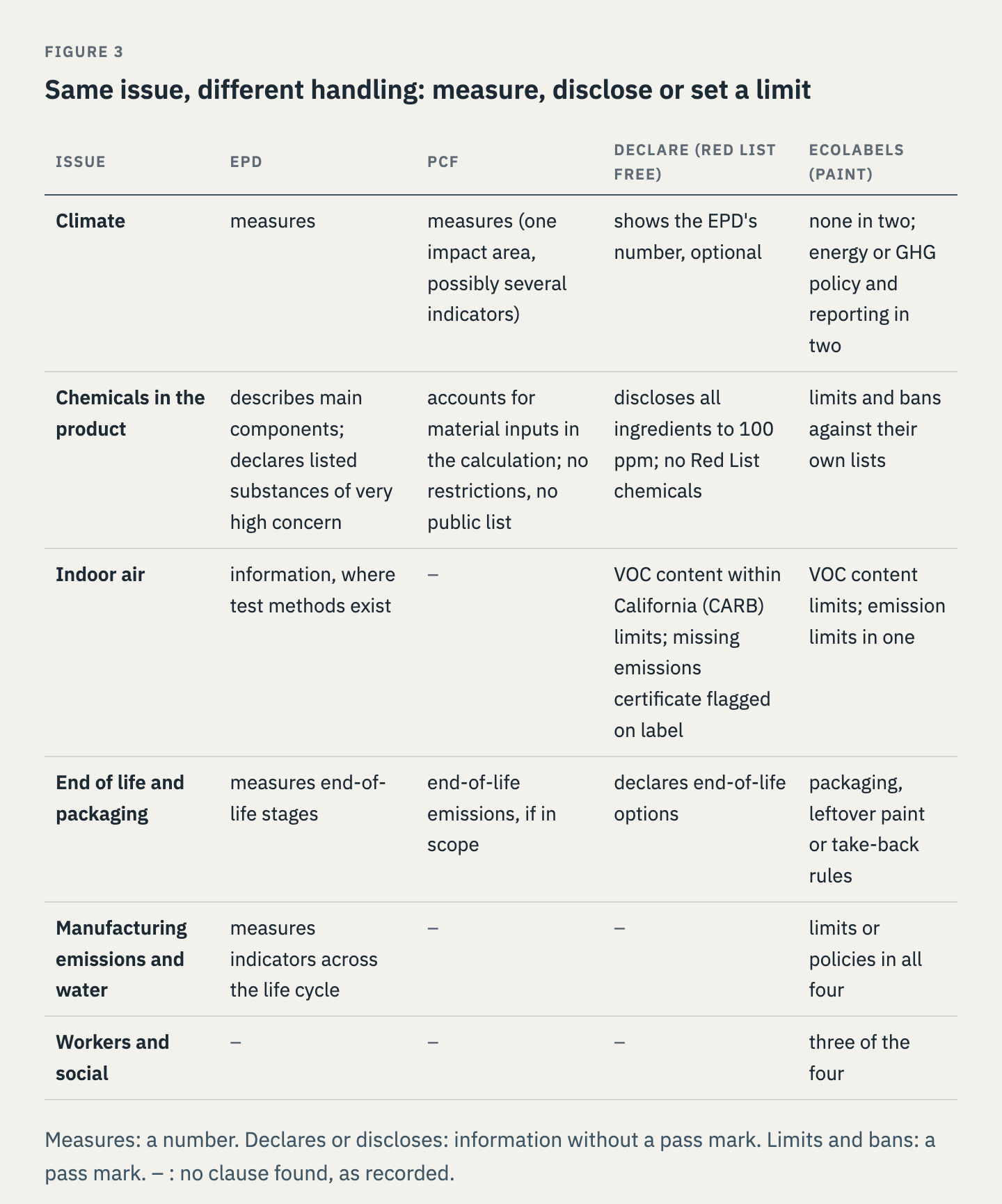
- Climate. The EPD and the PCF both measure climate, so a PCF adds little to an EPD. Declare can show embodied carbon, but only taken from a third-party verified EPD, so an EPD and Declare carry the same number. None of the four paint ecolabels requires an EPD, an LCA or a carbon number. Two have energy or greenhouse gas clauses, such as an energy policy, annual reporting or reduction targets, and two have none.
- Chemicals in the product. Declare and every paint ecolabel deal with this, in different ways. Declare discloses everything down to 100 ppm, and at Red List Free nothing on the Red List can be in the product, which is in effect a pass mark against one list. The ecolabels limit and ban substances against their own lists, and where they ask for the full formulation it goes to the certifier, not on the label. The EPD describes the main components and declares listed substances of very high concern above a threshold. A PCF has to account for the product's material inputs in its calculation, but the standard sets no restrictions on them and doesn't require a public list.
- Indoor air. The EPD gives information on what the product releases, where harmonised test methods exist. At Red List Free or Red List Approved, a paint's VOC content has to stay within the California Air Resources Board's suggested limits for coatings, and one over them can only be Declared. Interior products also need an emissions certificate, and a missing one is flagged on the label. The ecolabels set limits on VOC content, and the EU criteria also limit what the paint emits.
An EPD and an ecolabel touch many of the same issues but rarely tell you the same thing. The EPD measures and sets no pass mark, while the paint ecolabels set pass marks and don't measure carbon, so in this category each mostly adds to the other.
What each option answers
The third angle is the one I find most useful in practice: which questions each option answers, as I read the clauses.
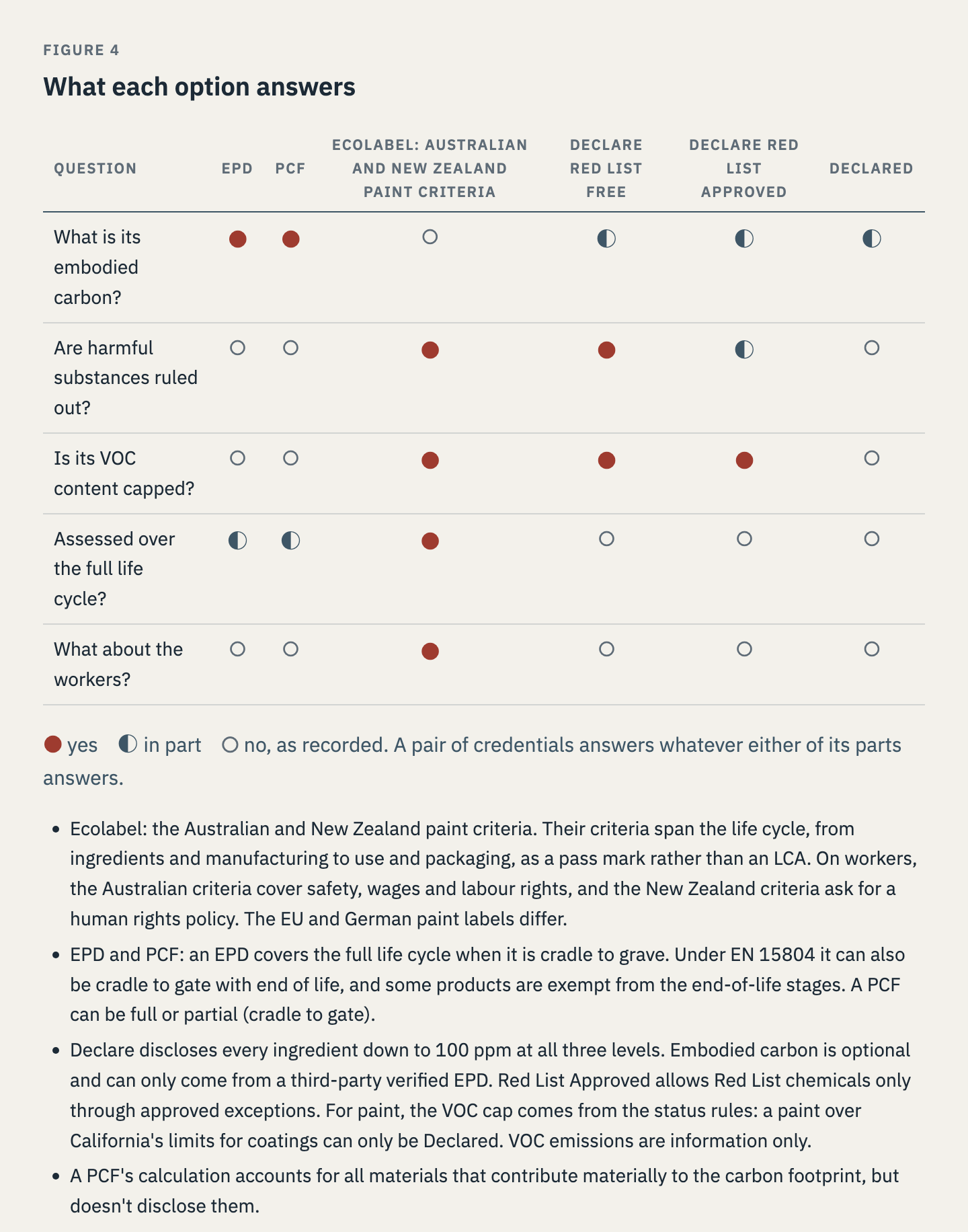
The figure shows each credential on its own, with Declare at each of its three levels; a pair answers whatever either of its parts answers. A few things stand out. Every option that includes an EPD or a PCF answers the carbon question, and none of the four paint ecolabels on its own does. Declare is the only one that discloses every ingredient down to 100 ppm, at all three levels, while an ecolabel answers "are harmful substances ruled out?" against its own list. Workers and conduct are answered only where an ecolabel is part of the set, and only by three of the four. And only the options that include an ecolabel set a pass mark across several issues. Declare at Red List Free sets a narrower one, on two issues: no Red List chemicals, and VOC content within California's limits. At the Declared level it is disclosure only.
If you don't have an EPD yet
For a manufacturer starting from scratch, the clauses suggest each first step leaves a different question open.
Starting with an ecolabel gives a pass mark across chemicals and indoor air, and often packaging and workers as well, depending on the label. It gives no carbon number. None of the four paint ecolabels asks for one, and two have no energy or climate clause.
Starting with a PCF gives the climate figures, verified or not. The calculation has to account for the product's material inputs, but the standard sets no restrictions on them and doesn't require a public list, so it tells you little about what is in the product and nothing about what it releases indoors.
Starting with an EPD gives the numbers across many indicators, a description of the main components, listed substances of very high concern and indoor-air information where methods exist, but no pass mark.
Whichever comes first, the later steps fill different gaps. An EPD added later to an ecolabel rarely repeats it, so it mostly adds. Declare's carbon field needs an EPD to fill it. And an ecolabel added to an EPD brings pass marks across several issues and, for three of the four paint labels, the workers.
Choosing the second credential
In practice, I would choose the second credential by the question you are being asked. If the question is "what's in it?", that is Declare's job, and the level on the label tells you how far it goes. If it is "has it passed something across several issues?" or "what about the people who made it?", that is an ecolabel's, and it pays to check which one. If it is the carbon number, the EPD already answers it and several more environmental and resource categories, and a PCF is the specialised version for the carbon number only.
With Klar Cite, an ecolabel goes from being just a label to a searchable database of what sits behind the certification, without having to read the whole standard. For this comparison I read the EPD rules, the carbon footprint standard and Declare's guide the same way, clause by clause.
Which product category, or which combination, would you like to see mapped next?
How this was mapped
The building blocks are the EN 15804:2012+A2:2019 core rules for construction product EPDs, ISO 14067:2018 (now under revision), the Declare Manufacturer's Guide v2.1 (July 2026; Declare's public pages at living-future.org), and four sets of Type I ecolabel criteria for interior paint, all current editions as recorded in build 2026-10-11-0932. The broad areas are my judgement, drawing on a clause-by-clause assessment, and a sample read of those assessments held for 17 of 20 clauses. The rules for an EPD or a PCF describe what has to be reported, not any product's results. A count of clauses is not a measure of rigour. In the Klar Cite app, each set of criteria links to its owner's document.
Method and sources: Klar Cite register, build 2026-10-11-0932. EPD counts as published by the programme operators and ConstructionLCA, accessed October 2026. They count registered, valid or published EPDs on different bases. Survey figures from my 2026 specifier and manufacturer surveys.