I wanted to know two things. What do the builders and developers actually ask for, when you read their public documents side by side? And how much of it can a product certification or declaration answer, so the supplier can cite the clause or point to it instead of writing another paragraph?
The documents
I read the public procurement and sustainability documents of eleven Australian builders and developers: four Tier 1 contractors, four Tier 2 builders and three developers. This includes supplier codes, procurement policies, ESG strategies, a contract schedule, a modern slavery statement, a playbook for suppliers and subcontractors. For contrast I read what the people upstream publish: about 75 architecture and interior practices and specification bodies, and seven infrastructure agencies, plus one software vendor's description of the data builders collect from suppliers (Catchment).
The documents are what these organisations choose to publish. Tenders and contracts can go further and two of the documents say their contract terms prevail where they are more onerous. Where dated, they run from 2019 to 2025. It rests only on what is publicly available, so it may be incomplete as a builder may ask for more in documents it doesn't publish.
What they ask
About half place requirements, expectations or preferences on suppliers in what they publish. The other half publish their own commitments in terms of targets for waste and carbon, a reconciliation action plan, an ISO 14001 certificate of their own.
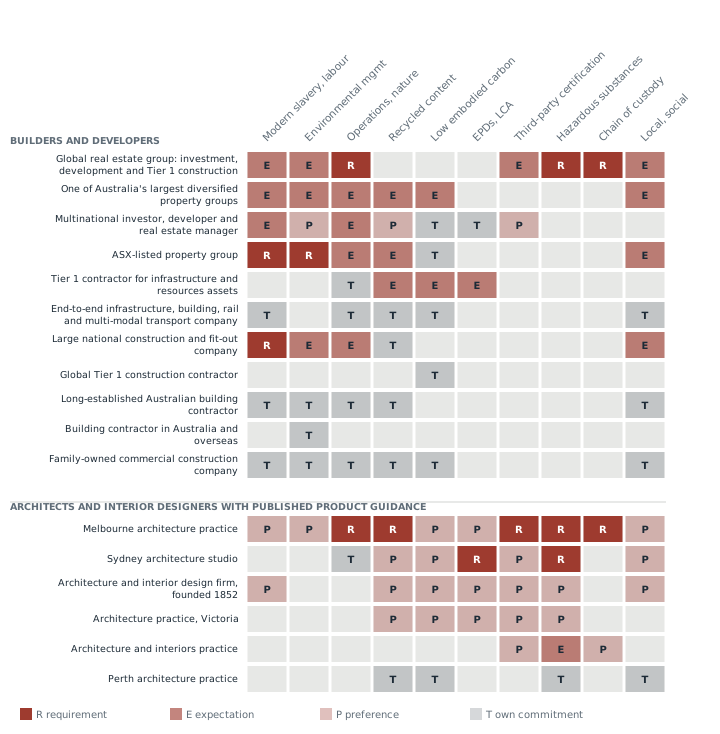
What those six ask is mostly about the supplier as an organisation. Most ask suppliers to rule out forced and child labour, and to look for modern slavery in their own supply chains. Most ask for an environmental policy or management system, a few name ISO 14001 as the reference. Most ask suppliers to manage waste, pollution, water or nature in their own operations. Some ask for local, Indigenous or social procurement, as a preference or a programme.
Asks about the product itself are fewer and more concentrated. Four ask for recycled or reused content. Two ask for materials with lower embodied carbon or energy, and one asks suppliers to measure and cut their own emissions. One links product data to EPDs or LCA: A playbook for suppliers and subcontractors asks for embodied carbon and recycled content per material, for example CO2e per cubic metre of a concrete mix or recycled content of steel by weight, and says that "Environmental Product Declarations (EPD), Life Cycle Assessment or other documentation is used to validate sustainability credentials" (CPB Contractors). One asks about hazardous substances, product conformity and traceability. Its contract schedule requires a safety data sheet for every product brought to site, and a hazardous chemicals register for those classified as hazardous; its supplier code expects due diligence on conflict minerals and "evidence of all required certifications and traceability of products" on request.
Interestingly, no builder or developer names a product label or certification scheme. One names EPDs as one kind of evidence (CPB Contractors). Otherwise, "verified ecolabels" in one policy and "recognised sustainability accreditations" in another are as specific as it gets. None of the builders' documents names FSC, PEFC, GECA, Declare or the Red List; the specifiers' guides do (Breathe; Bates Smart; Architects Declare; NATSPEC).
Could product labels answer everything?
I sorted the asks into ten themes and counted, for each, how many of the 110 product labels in Klar Cite set at least one requirement on it. A label "answers" a theme here only in the sense that it asks the question too. It does not satisfy any builder's clause, and a count of requirements doesn't say how demanding they are.
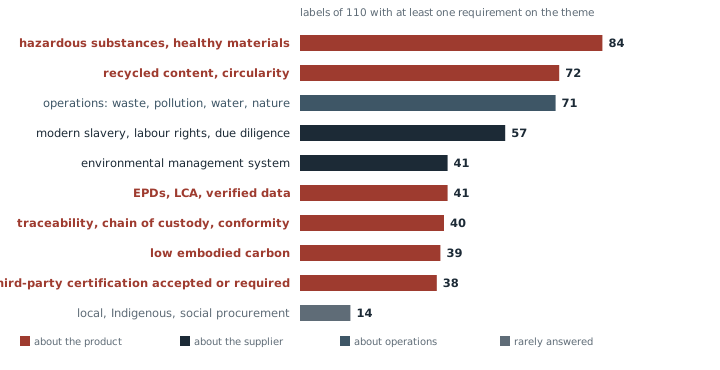
The product asks are widely answered. Hazardous substances are the subject of requirements in 84 of the 110 labels, recycled content and circularity in 72, verified product data such as an LCA or an EPD in 41, embodied carbon in 39. On the product half of the questionnaire, the labels ask much the same questions the builders do.
The organisational asks are answered by fewer labels. Modern slavery and labour rights are the subject of requirements in 57 labels, an environmental management system in 41. Most of those are product ecolabels that reach into the maker's own organisation, 37 of the 57 and 28 of the 41; the certifications of forests, steelworks, aluminium operations and concrete plants supply most of the rest.
Local, Indigenous and social procurement is answered by 14, and half of those are the credentials of one Australian scheme, which offers a local-procurement mark of its own. Where a supplier buys from is a property of the supplier, not of the product, and it will stay on the questionnaire.
One label, or two
No declaration covers all of the organisational half. EPDs, product carbon footprints, Declare, HPDs and a product health declaration report the product; none of the eight declarations in the map sets a requirement on an environmental management system or on local procurement, and no two of them together reach more than eight of the ten themes. Certifications, taken as a group, cover all ten. Almost no single label does: three credentials of one scheme set requirements on all ten, and no certification of a site, a plant or a source does on its own.
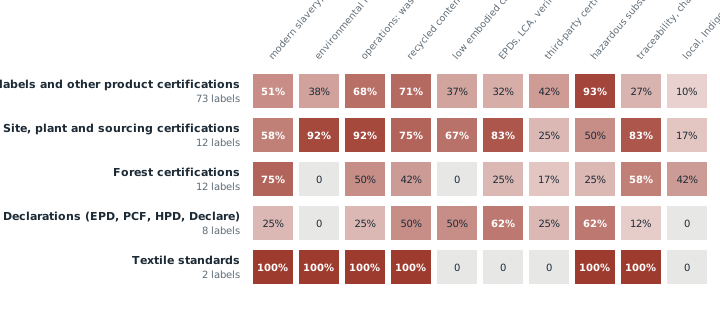
For most product certifications, covering all ten themes takes two labels, and for many it isn't possible with two:
- About a third of the other product certifications reach all ten themes when paired with a certification of a forest, a plant or a source, and nine more only when paired with another product certification.
- The other 37 reach nine with their best partner, never ten. None of them sets a requirement on embodied carbon or on traceability, the two themes most often left over.
- Half the declarations in the map set requirements on embodied carbon.
Builders and specifiers
Most builders, in their public documents, are not specific about products. Is that because nobody is, or because the specifics live somewhere else? To find out I read what the people upstream of the builder publish, matched to the kind of work. Architects and interior designers for buildings and fit-outs, and the government agencies that commission infrastructure from contractors.
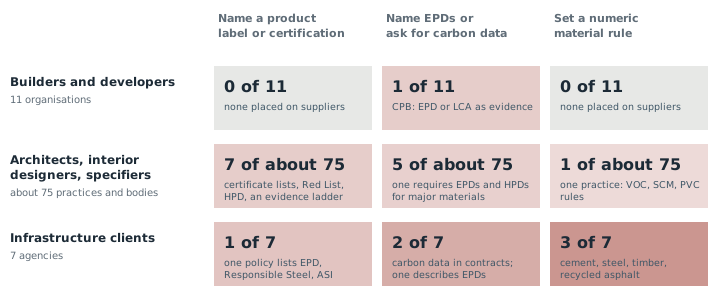
In my sample, the infrastructure clients publish the most numbers. Sydney Metro's 2019 sustainability strategy for its City & Southwest line set project targets its contractors had to show how they would meet:
- concrete with more than 25% Portland cement replacement on average,
- 60% of reinforcing steel made with energy-reducing processes, and
- timber that is 100% reused, recycled or responsibly sourced (Sydney Metro).
Queensland's Transport and Main Roads asks tenderers to nominate, product by product, the share of recycled material they propose to use, and its specifications allow reclaimed asphalt up to set limits by layer. Main Roads Western Australia has tonnage targets for crushed recycled concrete and has mandated crumb rubber in open-graded asphalt (Main Roads WA). Infrastructure NSW requires agencies, on projects over $50 million (building) or $100 million (other), to measure upfront carbon at three stages and to require contractors, through their contracts, to provide as-built data for reporting it. It is the one client document in my sample with a list of product certifications, including EPDs, Responsible Steel and the Aluminium Stewardship Initiative, among the ways to cut it (Infrastructure NSW). The figures CPB and John Holland publish, cement replacement and recycled content, are the same kind of numbers these clients set (John Holland; CPB Contractors; Main Roads WA; Sydney Metro).
The architects are a different story, but only some of them. Of the roughly 75 practices and bodies I read, most publish commitments, generic wording or nothing on materials:
- embodied-carbon targets for their projects,
- a carbon-neutral office,
- a signature on Architects Declare.
That is the same style as the builders. Six practices publish guidance on the products they specify, some of it as requirements, and it is about the product itself, where most builders' codes are about the supplier.
A few specific examples:
- Studio Prineas's action plan requires "Environmental Product Declarations (EPD) and Health Product Declarations (HPD) for all major materials" (Studio Prineas).
- Gresley Abas's action plan lists, among its steps for 2023 to 2030, "Only specify products/ materials with low VOC ratings and use formaldehyde free products" (Gresley Abas).
- Rob Mills chooses paints, glues and sealants "for low VOCs and formaldehyde" (Rob Mills).
- Kerstin Thompson's plan prioritises materials with EPDs and healthy or Red List-free materials (Kerstin Thompson Architects).
- Bates Smart's fit-out guide lists the certificates and declarations its designers should look for and sends suppliers a questionnaire of its own (Bates Smart).
Only Breathe, among the practices I read, publishes material benchmarks with numbers: paint under 1 g/L VOC, at least 30% fly ash or slag where structurally viable, no PVC flooring (Breathe). The guidance the profession shares points the same way. Architects Declare's materials guide sets out a ladder of evidence for each criterion, from certifications to EPDs, carbon footprints, Declare labels and HPDs, down to a manufacturer's affidavit (Architects Declare), and the national specification system gives the specifier the clauses to call up certified timber or an EPD for nominated products, but leaves them off unless the specifier switches them on (NATSPEC).
So the product rules are real, but they arrive with the project in the client's specification, the architect's specification and the rating tool. The builder's code governs the relationship with the supplier. A supplier answering a builder's code of conduct is answering the builder; most of the product evidence is asked for with the project, against the specification. That said, architects' project specifications are not published, so what I can compare is what each side publishes openly.
On rated projects, the bar goes up
Everything above describes what a builder asks on any project. When the project is built to a rating tool, the bar for products rises, and part of the rise is chosen project by project. Green Star (GBCA) sets Minimum Expectations that every rated building must meet, such as a 10% upfront carbon reduction (against a benchmark or a reference building), and paints, adhesives, sealants, carpets and engineered wood that are low in toxins shown by a recognised certification or a laboratory test.
At 5 and 6 Star, the upfront carbon credit itself becomes compulsory. The product credits are more flexible. The share of structure, envelope, systems and finishes that must reach a Responsible Products Value, scored from recognised labels and declarations, is a set of credits a project team decides to target.
LEED v5 (USGBC) makes quantifying embodied carbon a prerequisite; reducing it and choosing products are credits, though a Platinum project must show a 20% cut.
On infrastructure, Main Roads Western Australia has committed that its construction projects achieve at least a Silver IS rating, for design and as built (Main Roads WA).
So the same product can face very different questions from the same builder: a code of conduct on an unrated project, and a request for certificates, EPDs and VOC test reports on a 6 Star one. The matrix above describes the first case; on any Green Star project, low-toxin finishes are already part of the minimum.
The frameworks behind the documents
Two public frameworks set procurement expectations of their own, and both are in Klar Cite as demand sources. The Commonwealth's Environmentally Sustainable Procurement Policy (DCCEEW) asks agencies to report, across their procurements, the share of contracts where "the supplier holds a third-party environmental certification"; for construction, whether a project achieves a Green Star or IS Rating, or a NABERS Embodied Carbon rating of 4 stars or more; and, from phase 2, the share of products with recycled content. It recognises thirteen programmes held in the map, mostly for furniture, fixtures and equipment and for textiles. The IS Rating's sustainable procurement credits (ISC) ask a contractor to put sustainability requirements into tenders and contracts and to report supplier performance; CPB lists the council that runs it among its memberships (CPB Contractors).
Green Star sits behind the rest. Its Responsible Products framework recognises 157 entries, across 22 schemes, that the map holds, and it is the rating tool that two of the builders name, as ratings they deliver.
What to do with this
If you are a supplier, the questionnaire is not going away, and most of it is about you: how you treat workers and how you manage your own environmental impact. No label replaces that, and the theme most of the eleven address, modern slavery (eight of them, five as an ask of suppliers), is answered by 57 labels only in the sense that they ask it too. But on the product half, recycled content, embodied carbon, substances, verified data, labels ask the same questions, and the map shows which label asks which.
If you are a builder, the same map reads the other way. The product part of your questionnaire could be answered by a label the supplier already holds, if the question is put precisely enough for a label to answer it.
Which part of your questionnaire could a label answer for you?
How this was mapped
Demand side: the public documents of eleven Australian builders and developers, chosen by me and read on 18 October 2026, classified into ten themes as a requirement, an expectation, a preference or the organisation's own commitment; every cell checked by me. Upstream: about 75 architecture and interiors practices and bodies (two searches) and seven infrastructure agencies (web pages read 18 October, PDFs 19 October 2026), matched by kind of work; the six specifier rows in Figure 1 are the practices that publish product-level material guidance, selected from them; what each side publishes openly is compared, not project specifications. Only public documents were read, so the picture may be incomplete. The matrix describes what applies on any project; on projects built to Green Star, LEED or IS, product requirements rise with the rating's minimum requirements and the credits targeted (rating-tool rows from the register's demand side, build 2026-10-17-0230). NATSPEC's licensed worksections are characterised, not reproduced. Legal compliance, safety systems, business ethics and reporting mechanics appear in nearly every document and are left out as assumed. Supply side: Klar Cite register, build 2026-10-17-0230, the 110 labels that certify construction products, current editions, textile standards included; a label counts on a theme when at least one of its requirements concerns it, matched by the register's topic layer, by three clause-by-clause re-reads (circularity, social, nature) and by text patterns, with read samples of 20 for the text-based themes. Counts are floors for the re-read themes and indicative for the rest. Demand counts and label counts are never combined. A count of requirements is not a measure of rigour. The five areas follow mindful MATERIALS' Common Materials Framework.
Method and sources: Klar Cite register, build 2026-10-17-0230. Documents and web pages accessed 18 and 19 October 2026.