We have known for a long time that the materials we build our homes, precincts and cities with can change lives. They affect our health, the climate, ecosystems and communities, directly through what we breathe and touch every day, and indirectly through how they are made and where they end up. I think they can also be one of the bigger levers we have for a more sustainable future, so it is no wonder that so much effort goes into measuring, labelling and certifying products and buildings.
The result is a lot of logos. The ecolabel criteria for low-emission floor adhesives in the map address indoor air and chemicals, and little else. An Australian ecolabel's criteria for carpets address similar emissions and substances, and then go on to energy, water, circularity, and labour conditions such as minimum wages and modern slavery. Both labels refer to the international standard for ecolabels, ISO 14024, one as based on it and the other as in line with its principles, and both are legitimate ways to run a label. On a product data sheet they look much the same.
As I came to read them, most of the differences between credentials are differences in purpose, and which purpose is right depends on what you want to know about a product.
Why read behind the logo
This year I asked both sides of the market about the same decision. I contacted over 150 architects, ESD and engineering consultants, developers, asset owners, builders and government clients across Australia and New Zealand, and about one in five answered. On the supply side I asked around 80 people at close to 60 manufacturers, and more than one in four answered. Neither sample represents the whole market, so I read the results as a pattern rather than a measurement. Of the specifiers who left a comment, 57% asked for verified evidence over marketing claims, or for credentials that are easier to find. Half want a certified label on top of an EPD, and for flooring and finishes 70% ask for a health declaration, a label, or carbon plus a label. The manufacturers who answered all hold EPDs, and only one of them finds what the certification schemes require, and how they relate to each other, clear and consistent. Another put it more bluntly than I would: labels "promote the brand, but not the standards that they rate to".
Policy points the same way, at least for consumers. In Europe, a 2020 study for the Commission found 53% of the environmental claims it examined vague, misleading or unfounded, and the Commission counts at least 230 sustainability labels in the EU. Since 27 September 2026, a sustainability label on products sold to EU consumers has to be based on a certification scheme or set up by a public authority. Those are consumer-market figures, but the Ecolabel Index lists 119 labels for building products on its own. Nobody reads the criteria behind 119 labels before choosing a floor.
So we gathered the schemes and rating tools that come up for building products in Australia and New Zealand, and put every requirement we found in one place.
How the map was built
Klar Cite holds 453 documents. 241 of them were mapped into 20,160 requirements across 40 schemes and rating tools: 31 schemes (30 that issue credentials, plus one standards body), 8 rating tools and one procurement policy. The other 212 documents produced no requirement rows, and they include 68 held as context. The count follows the register's convention and includes about 1,900 informative and template rows.
Each requirement is taken from the wording the scheme or standards body published, and 96.7% of the rows that can be checked against the source document are verbatim or close quotes.
A requirement is one clause as the scheme or standards body published it, so counts depend on drafting style. The median credential has 39 rows in its current editions, and the median by type runs from 15 to 62. A count is not a measure of rigour, and I don't use it as one. Every count from the register is as recorded in build 2026-10-11-0932. The Klar Cite app shows the product view, so some whole-register counts here, and some wording that publishers don't allow to be shown, won't appear there.
Where the options are
Looking across everything the map holds, one useful way to sort credentials is by what kind of promise they make. All but one fall into four kinds: a certification covering several issues, a certification covering one issue, a declaration covering several issues (the EPD), or a declaration covering one issue, such as a carbon footprint or a health disclosure. Almost all of them are checked by someone other than the company making the claim. Only 3 of the 167 current credentials allow the publisher to self-declare, and all three are declarations.
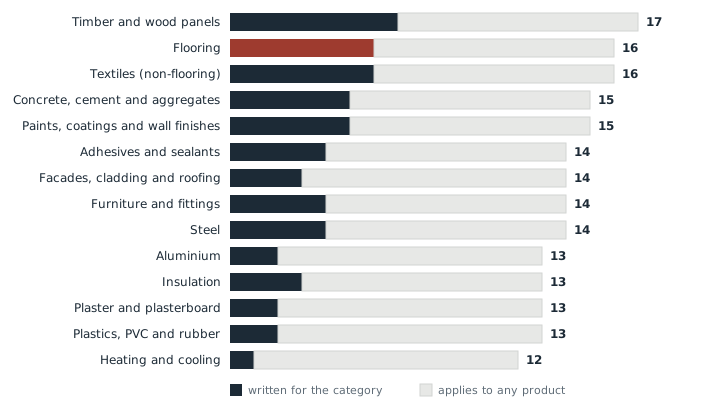
What surprised me more is how many options a single product has. For each of 14 product categories, a product can carry credentials from somewhere between 12 and 17 of the schemes held. Ten or eleven of those apply to any product: EPDs and carbon footprints, health declarations, a carbon-neutral certification, an emissions certification, and a handful of multi-attribute certifications. The rest are written for the category, from 7 for timber and wood panels and 6 for flooring to one for heating and cooling products. Most of the choice, in other words, is general-purpose, and the category-specific options are the ones written with that product in mind.
The other useful way to sort them is by what they address. Of the 167 current credentials, 110 are ones a construction product can name on its certificate or declaration. The rest are programme rules, governance and supporting documents, one service, and an older edition of one standard that is still listed as current. In my judgement, drawing on a clause-by-clause assessment of their requirements against five broad areas (health, climate, circularity, social and equity, and ecosystems), they spread like this:
| Broad areas reached | 5 | 4 | 3 | 2 | 1 | None |
|---|---|---|---|---|---|---|
| Credentials | 56 | 22 | 14 | 1 | 15 | 2 |
My judgement of which broad areas each of 110 product credentials relates to, counting an area where any of its requirements is assessed to it, as the clause's main area or a secondary one. Counting main areas only, the spread is 41, 27, 18, 5, 17 and 2. One clause is enough to count an area, so this shows reach, not depth, and a clause read to the wrong area, or shared by several marks of one scheme, adds an area. "None" means no requirement was assessed to one of the five areas, not that the credential addresses nothing. As recorded in build 2026-10-11-0932.
Nearly all multi-attribute certifications reach four or five areas (71 of 80). Single-issue certifications split: 10 of the 22 reach one area or none, and 11 reach three or more, on this generous count. The extra areas mostly come from general clauses on chemical law or labour and social compliance, from recycled-content accounting in chain-of-custody standards, and in one scheme from clauses its several marks share. I'd check which kind you are holding before leaning on it.
What a credential asks of a product
When I read the flooring documents clause by clause, most requirements turned out to be pass or fail: they set a level or ban something. The rest ask for disclosure, a plan or policy, or monitoring.
Not every clause is a requirement on a product or company. Some are rules for the certifier, informative text, test methods, label-use rules, exemptions and definitions, and the share varies a lot between credentials. That matters when someone quotes how many requirements a credential has, and it is one more reason I treat counts with care.
I also didn't expect how rarely a clause says how it will be proven. Most flooring requirements name no evidence in the clause itself. The proof usually sits elsewhere, in the scheme's own procedures. It means two credentials with similar-looking requirements can be checked quite differently, and the logo won't tell you which.
Across current credential requirements, as the register's rules classify them, over half bind the company applying (a manufacturer, a forest manager, a mill or an EPD owner), about a quarter bind the product itself, and about one in twelve name no party the rules can determine. A credential is often as much about the organisation behind the product as the product.
Same topic, different methods: indoor emissions
The topics overlap more than the logos suggest. Greenhouse gas emissions and recycled content are mentioned in clauses of 22 of the 30 credential schemes, and energy in about 20. Mentioned is the right word: a mention can be a requirement, a definition or an exemption, and I count it as breadth only.
How a topic is assessed is where schemes go their own way, and indoor emissions are the clearest example. The clauses assess emissions in at least seven ways, as I group them:
- Limits on what the product contains, such as a VOC content in percent by weight.
- Chamber tests that measure what the product emits, under one of several test standards.
- Evaluation against a health-based scheme, where chamber results are compared with a list of substance limits.
- For formaldehyde from wood panels, reference classes and desiccator or perforator tests.
- Odour tests, found in one scheme's clauses and optional in some of its documents.
- Accepting another emission label as proof.
- Disclosing the test results without a pass mark.
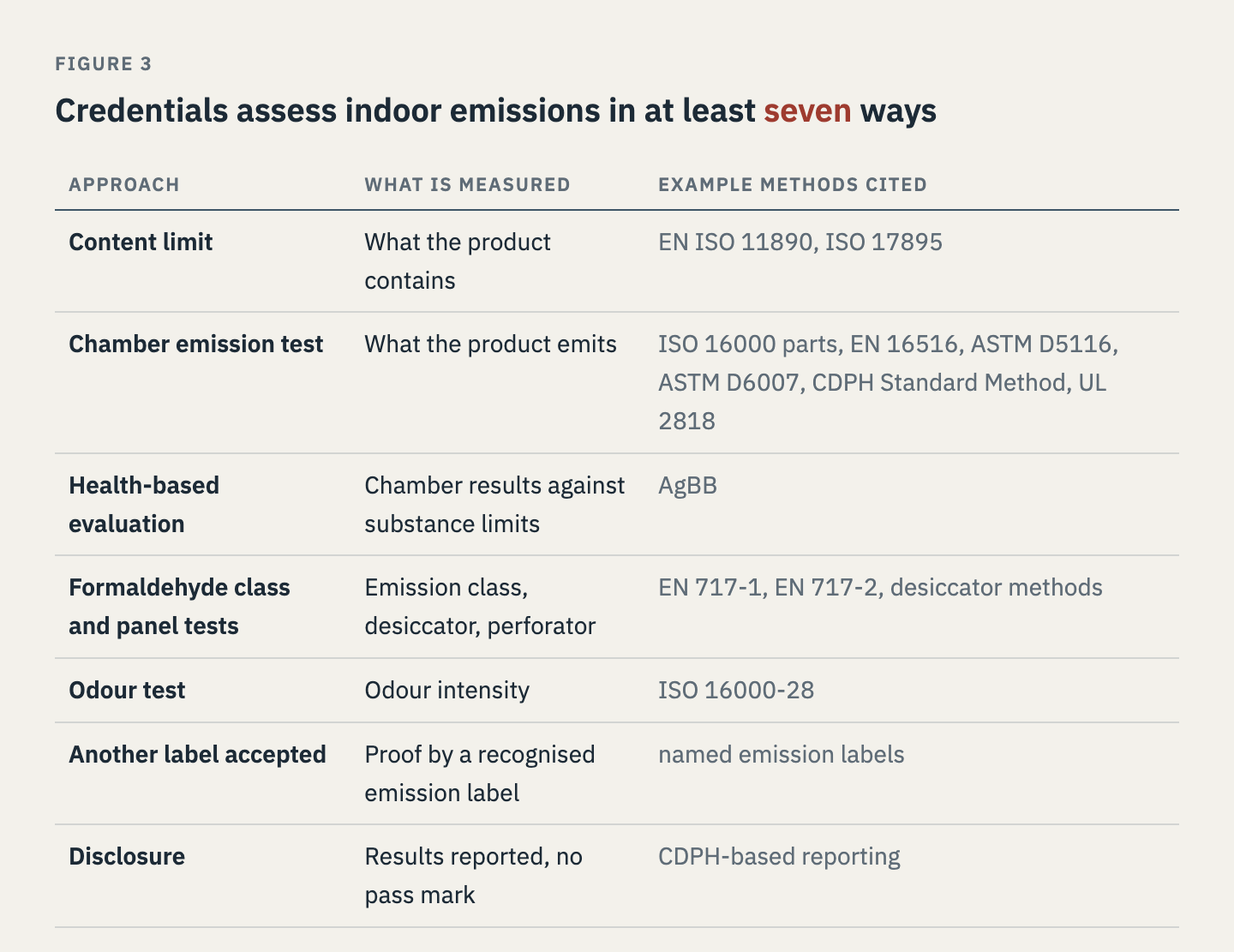
Between them, the credentials' clauses cite at least 14 named test methods and evaluation schemes. Even a single substance can be limited in the product itself or on what the product releases, so "meets the formaldehyde limit" means little until you know which.
Same substance, different obligation
The bigger difference shows up when a product holds several credentials. I took three that are common on carpet in Australia: an ecolabel written for any product, the carpet industry's own scheme, and an Australian ecolabel written for carpets. Their requirements share a long list of topics, from VOC emissions and formaldehyde to phthalates, heavy metals, water use and end of life, although in one of the three many of these rest on a single clause. A shared topic doesn't mean a shared obligation, though.
Lead and cadmium are banned or restricted in all three, and all three test VOC emissions against limits. Phthalates are where they part ways: the carpet ecolabel bans them, the any-product ecolabel caps named phthalates at 0.01% in flooring, after a time-limited allowance for products above it, and the industry scheme lists several of them as chemicals of concern to be reviewed regularly. Antimony trioxide follows a similar pattern: one prohibits it (while allowing antimony-oxide flame retardants bound into the polymer), another limits antimony in polyester fibre, and the third has it on its review list. Three logos on one carpet can mean three quite different answers to "is it in there?".
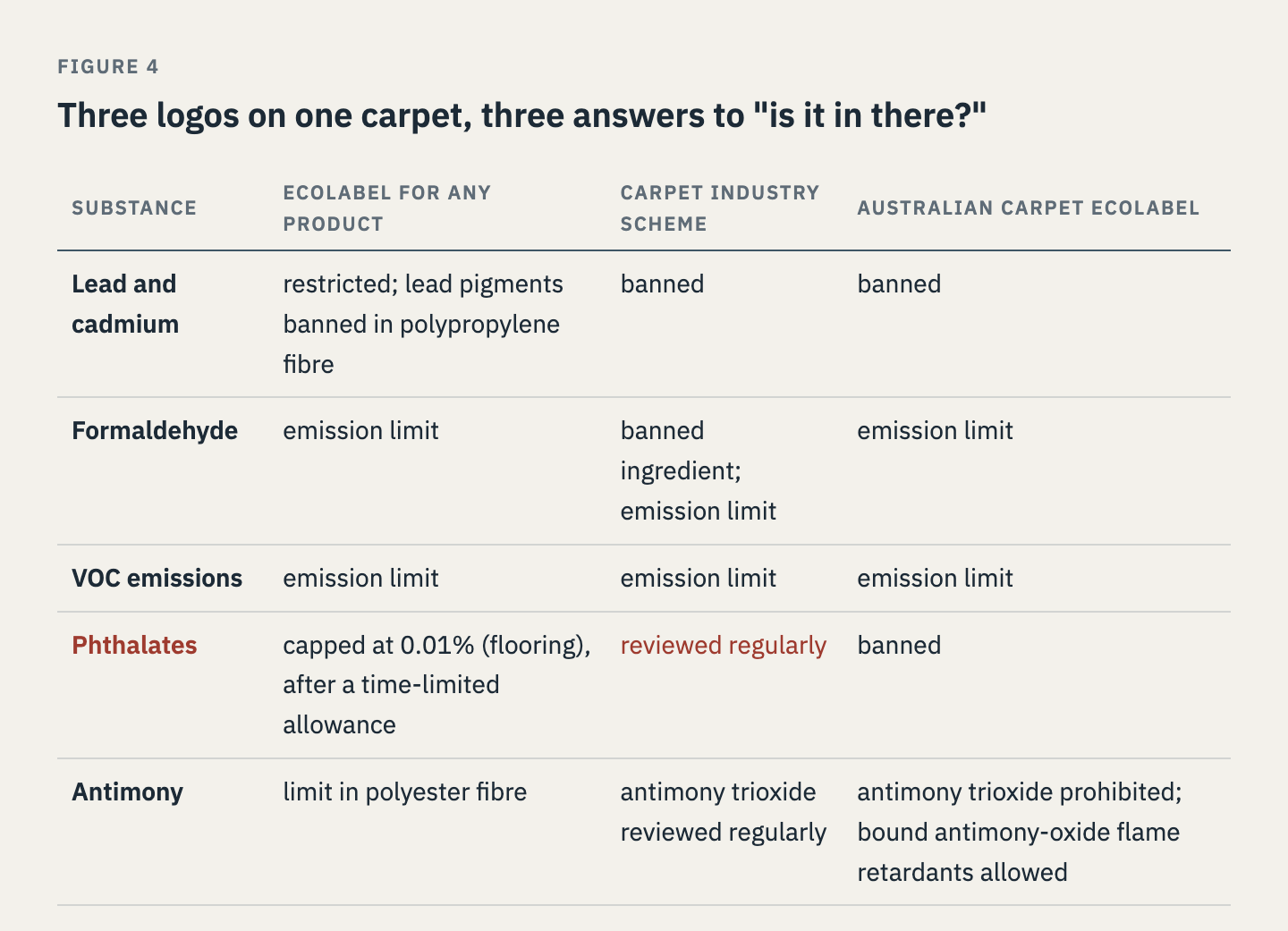
For a manufacturer that suggests some evidence may serve more than one scheme, but it has to be read against each scheme's own wording.
Same topic, different methods: recycled content
Recycled content looks simpler, a percentage, and it turns out to be just as varied. The minimum shares recorded in the map run from 5% to 100%, and they are set on different things: the whole product, a single component such as the paper or the aggregate, the fibre the product is made of, or even its packaging. Some count only post-consumer material, some set a post-consumer minimum within the total, and others accept post-industrial or pre-consumer waste as well, and most don't say. A 30% in one scheme and a 30% in another are not the same 30%.
In my view there are good reasons for the spread. A minimum has to reflect what the material can take without losing quality or performance, what recycled supply actually exists in the region, and what counts as a reasonable stretch for that industry, and those differ between plasterboard paper, concrete aggregate and insulation fibre. The percentage is also only one of the ways schemes deal with recycled content. Across the clauses in the map, it shows up in at least five forms, as I group them:
- A minimum share, on one of the bases above.
- Disclosure, where the manufacturer declares the recycled content of each material without a pass mark.
- Proof of origin, where recycled material has to be backed by a recycled-content certificate or by the recycler's own documentation.
- Safety of the recycled input, where recycled plastic, rubber, foam or wood has to meet limits for harmful substances, or a standard for recycled wood, and occasionally the reverse, a limit that is relaxed for recycled material.
- Definitions and calculation rules, from what counts as pre- and post-consumer to how recycled content is calculated and claimed.
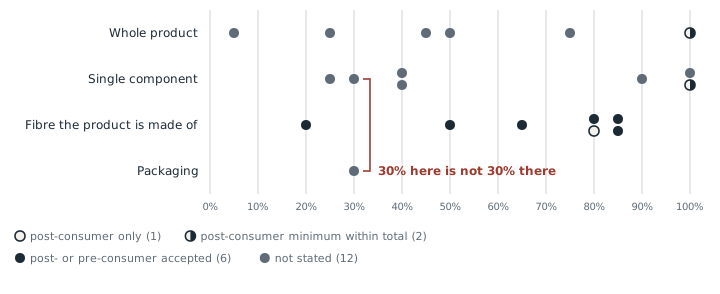
For a specifier, a percentage only means something once you know what it is a share of, where the material came from and how it was checked. For a manufacturer it means one recycled-content figure may not serve every scheme as it stands.
Rating tools: clarity and more credentials
In the map, 26 of the 30 credential schemes are named in at least one rating tool's or policy's list, as recorded. In my view, rating tools and procurement policies drive much of the demand for product declarations and certifications, and they play two roles at once. They clarify, by turning recognition into credit requirements and guidance that a project team can follow. And they add to the proliferation, because every recognition is a signal, and industry bodies and certification schemes see the opportunity, or feel compelled, to add another option to the menu of product credentials.
Labels differ, by design
If there is one obvious conclusion from building the map, it is that labels differ in ways the logo doesn't show, and most of those differences are deliberate choices:
- Their nature differs. Some declare, for transparency and data. Others certify, to help you find environmentally preferable products.
- Their breadth differs. Some reach across health, climate, circularity, social and equity, and ecosystems. Others focus on a single issue.
- Their scope differs. Some apply to any product. Others are written for one product category or material.
- Their obligations differ. Some require a substance to be absent. Others set a cap or ask for regular review, and some ask only for disclosure.
- Their recognition differs. Some are named across the main rating tools and procurement policies, others in only one or two, which doesn't make them less useful.
- Their cost and effort differ, in my view, even where a product could technically meet several, so it pays to compare what each actually requires before choosing.
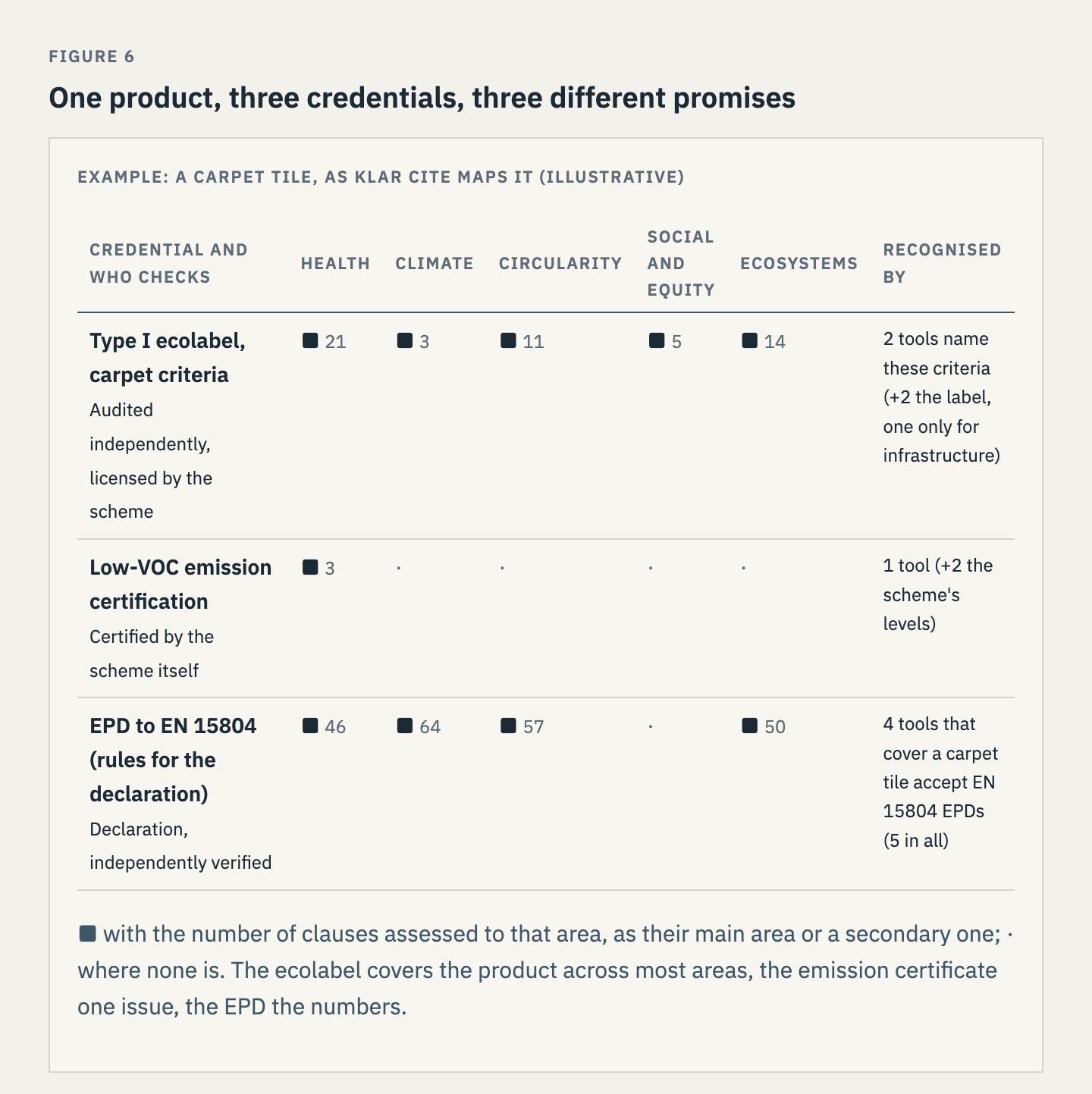
In practice it comes down to what you want to know about a product.
Do you want a credential targeted at your material? There are more options than most people expect. At least 7 schemes have credentials aimed at timber, at least 4 at steel, at least 4 at concrete and cement, and 2 each at aluminium and PVC. Some are material schemes that follow the supply chain from forest or smelter to product. Others are ecolabel criteria written for that product group. They answer different questions. A chain-of-custody certificate tells you where the timber came from, an ecolabel for panel boards tells you about the board.
Do you want peace of mind that the key issues are covered? A Type I ecolabel may be what you need, but they are not all the same. Some are concentrated on one issue: the low-emission criteria for floor adhesives and sealants address indoor air and chemicals only. Others cover health, energy, water and effluent, circularity, and labour and social conditions in one document, as the carpet criteria in my opening do. Both labels refer to ISO 14024, which was revised in 2026, after both sets of criteria were written. Ecolabel programmes read its life-cycle approach as a reason to set criteria where a product group's impacts are most significant, and two European ecolabels' own rules say so. The adhesives criteria apply that thinking to one issue. Breadth varies within one scheme too: the same Australian label's criteria for other floor coverings have no energy clause, as recorded. If you need breadth, read the product group's criteria as well as the logo.
Do you want numbers? Then you want an EPD or a product carbon footprint, and you get the number, independently verified in the case of an EPD. What you don't get is a verdict. An EPD or a carbon footprint discloses, it doesn't set a pass mark, so it won't tell you whether the number is good, or whether a deal-breaking issue such as a restricted substance was checked. You also give up the simplicity of a logo you can recognise across a room. Half the specifiers I surveyed want both: the EPD for the number, and a certified label on top.
What does an ecolabel tell you about embodied carbon? Mostly something indirect. 34 of the 58 current Type I criteria documents in the map set requirements on energy, such as a management programme, reporting, a consumption limit or a renewable share in manufacturing. A few go further: 5 limit the carbon intensity of making a material such as aluminium, cement or steel, in one case as one of several routes, and 6 require the number itself, an EN 15804 EPD, a declared product GWP or a GWP limit. Those six all belong to one German ecolabel. If upfront carbon is what you are being asked for, the ecolabel and the EPD answer different questions.
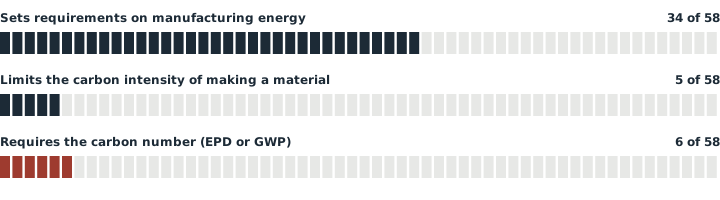
A logo tells you which kind of promise was made. The clauses behind it tell you what was asked and who checked it.
Where we are, and how I use the map
The market has more good credentials than it can easily read, and a rating tool, a procurement policy and a specifier may each ask for a different one. That is a reasonable outcome of many people working on different problems. What has been missing is a way to see across it.
That is what Klar Cite is for. Day to day, it answers the questions that otherwise take an afternoon: what does this logo actually require, which rating tools recognise it, and what did the credentials a product holds require of it. For longer-term decisions it compares numeric limits across schemes, shows which rating tools and policies name a credential and where they apply, and lists which clauses changed in each release. Every answer points back to the clause and the document it came from.
I would like to hear where the map is wrong or incomplete, because it will be. If you specify products, which question do you most need answered behind a logo? And if you make them, which two credentials' requirements would you most like to see side by side?
Method and sources: Klar Cite register, build 2026-10-11-0932, the build the Klar Cite app serves. The clause-by-clause reading of the flooring documents was done on the preceding research build. The findings cited above, and the external evidence they draw on, are held in the research ledgers. Rating tools as recorded in their public lists, accessed September to October 2026.