When I asked specifiers this year what they want from a label on top of an EPD, circularity was at the top of the list, alongside material health: 88% of those who want a label named it. It is easy to see why. Most of what we build ends up somewhere, and a product that lasts longer, comes apart cleanly or goes back into something useful is a better product for it.
It is also the hardest area to pin down. A review of the research literature analysed 221 definitions of the circular economy published in the five years after an earlier study had found 95, and found the idea both settling and splintering at the same time. So before counting anything, I had to decide what I would count.
What I mean by circular
The definition most people reach for is the Ellen MacArthur Foundation's: "a system where materials never become waste and nature is regenerated", one that keeps products and materials in circulation and tackles "climate change and other global challenges, like biodiversity loss, waste, and pollution". As a vision it is hard to argue with, but as a category for reading requirements it is very broad, because it also takes in climate, biodiversity and pollution, which the map counts in their own areas.
The map already gives climate and ecosystems their own categories, so I draw a narrower line. Here, circularity means how materials flow: what goes into a product, how long it and its parts stay in use, and what happens at the end, with packaging and the waste made along the way included. My grouping draws on several frameworks, including mindful MATERIALS' Common Materials Framework (CMF), but the line I draw around circularity is my own.
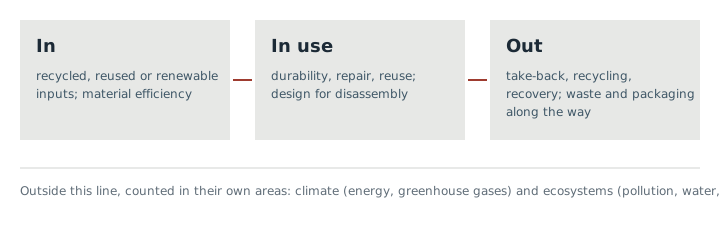
A carbon saving from recycled steel counts as climate, and a limit on what a factory discharges to a river counts as ecosystems. What lands in circularity is the material flow itself.
How owners describe their aims, and what their requirements ask
The first question was simple: which credentials describe circularity as an aim, and which set requirements on it?
In their own documents, the language is rarer than I expected. Of the credential schemes in the map, 14 use circular-economy or related wording somewhere in their documents. Only 2 make circularity a named category, as a scoring category or a stand-alone standard of its own. Most of the rest use the words inside a specific requirement, and the others only in passing.
The requirements give a wider picture. 23 schemes set at least one requirement that, read clause by clause, is about circularity. Eleven of those use the words circular or circularity themselves somewhere in their documents, and twelve don't. On their websites, some owners use circular-economy language more than their standards do, a Nordic ecolabel and a New Zealand one among them. Others set durability, repair and disassembly requirements without using the term in the criteria. The EU's furniture criteria are an example.
Some schemes describe the same intent in other terms. An Australian ecolabel, for example, lists "lifecycle performance" among what its standards assess, and frames them around a product's entire lifecycle, without calling it circularity. The wording counts above include only schemes that use circular or directly related terms, so they understate how many share the intent. The mechanism counts that follow don't depend on wording at all: they come from what each clause asks.
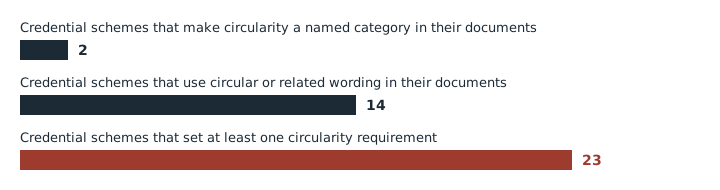
The word and the requirement don't always match, what tells you something is the mechanism.
How it is done
On Klar Cite, 760 clauses are assessed mainly to circularity. Read again one by one, 731 of them, from 25 certification, labelling and declaration schemes, hold as circular in full or in part. 587 of those belong to the 110 credentials a construction product can carry, and 534 of them are requirements, the rest being methods, definitions, guidance and exemptions. At least 83 of the 110 credentials set one or more of these requirements. Sorted by what they ask, the picture is uneven.
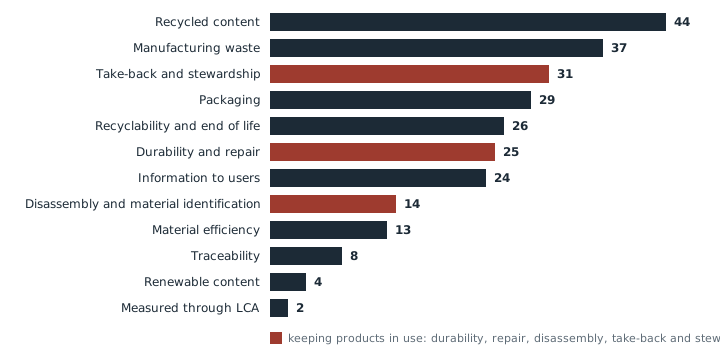
Recycled content leads, set by 44 credentials, followed by rules on waste in manufacturing (37), take-back and product stewardship (31), packaging (29) and recyclability or end of life (26). Durability and repair come next (25), with information to users on care and disposal close behind (24). Design for disassembly and material identification (14), material efficiency (13) and renewable inputs (4) are much rarer.
The usual circular-economy hierarchies put keeping things in use first, through durability, repair, reuse and disassembly, and recycling later. In the credentials, recycled content and waste in manufacturing come first, take-back (which can feed reuse or recycling) sits in between, and durability, repair and disassembly come after. In my view that reflects what is easiest to specify and check: a recycled-content share or a waste plan is easier to audit than a promise that a product will be repaired in fifteen years.
Counting credentials, and taking the strongest framing in each clause as I read it, 64 have a qualitative obligation (provide take-back, make it separable) and 51 a numeric minimum or limit, while fewer rest on disclosure (37), a plan or policy (36) or an outright ban (24).
Under EN 15804+A2 (clause 5.2), an EPD has to declare the end-of-life stages and the benefits beyond the product's life (module D) unless the product meets the standard's exemption conditions. That is an obligation to measure and report, with no pass mark, and most of the standard's clauses on it are rules for how to measure. It gives you the numbers but leaves the judgement to you. In my view, that reporting on end of life is what lets circular decisions be made further down the line.
A dedicated circularity index is rarer still. Take the Ellen MacArthur Foundation's Material Circularity Indicator (MCI): it appears in only one document in the map, a declaration standard from an Australian certifier, which discusses it and scores material circularity with the WBCSD's Circular Transition Indicators instead.
One product: furniture
Furniture is a good test, because how long a chair lasts and whether it comes apart matter as much as what it is made of. Five credential documents in the map carry "furniture" in their name and set circularity requirements: Australian, EU and New Zealand criteria, and two German low-emission labels, one for wooden and one for upholstered furniture.
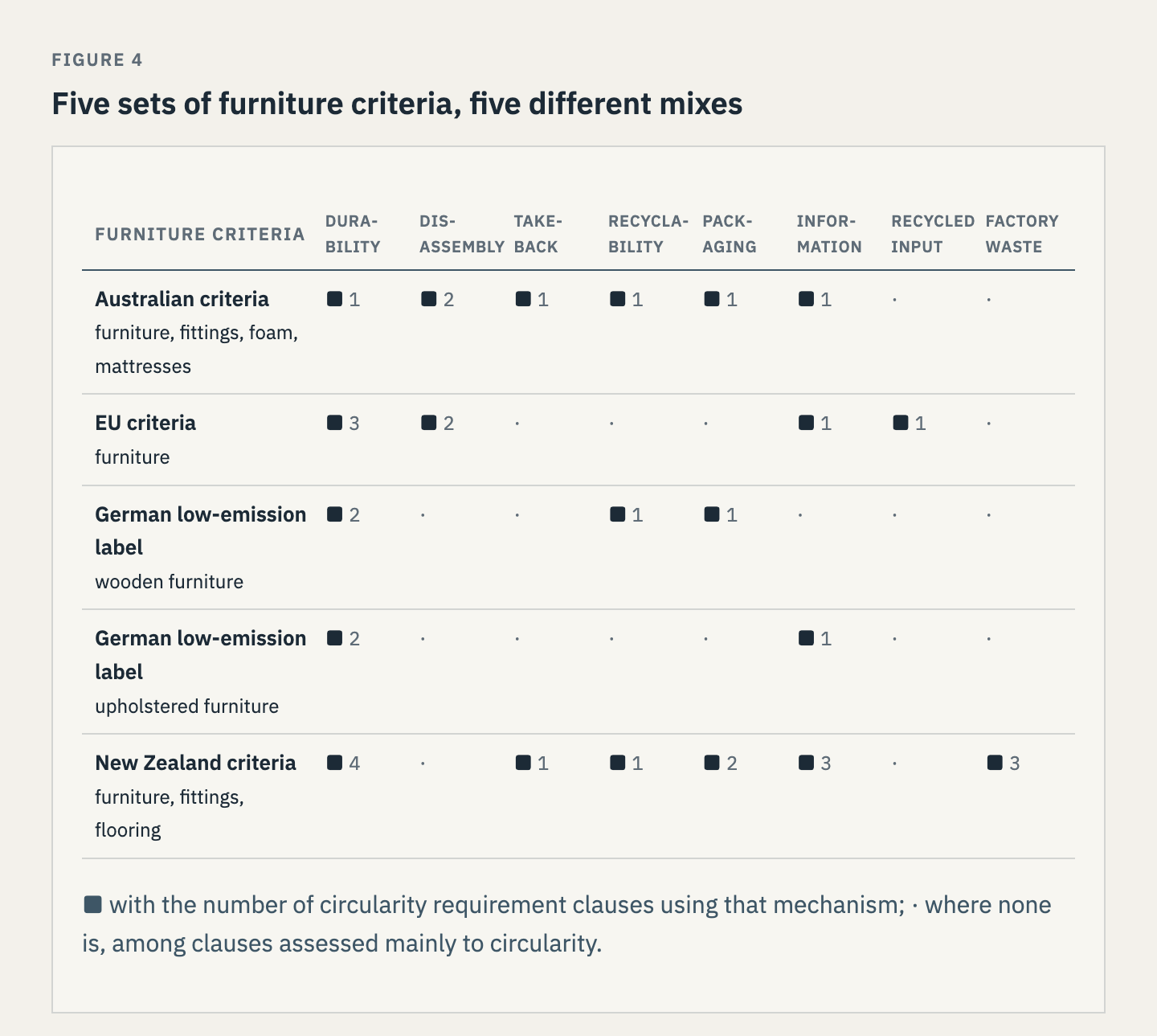
Each mixes the loops differently. The EU criteria lean on durability and design for disassembly. The New Zealand criteria add manufacturing waste, packaging and information on care. The Australian criteria cover disassembly and take-back along with durability. The German labels, built mainly around emissions, still carry durability requirements. A specifier who asks for "circular furniture" could be handed any of these and get a different answer to the question they meant.
Rating tools, in passing
Rating tools approach circularity at the scale of the building. Green Star's owner has set out a vision of "a healthy, resilient, positive and circular built environment", with a planned roadmap, guidance on circular procurement, and Green Star itself as a lever to push supply chains towards lower-carbon and more circular approaches. The Living Building Challenge, run by the International Living Future Institute, embeds circularity through its Materials Petal, which includes a Net Positive Waste imperative that treats waste as a resource. The Institute carries the same thinking into its product certification, the Living Product Challenge, whose Materials petal is about "supporting a circular and regenerative economy by creating products that use healthy and safe inputs, and eliminating concepts of waste". Some tools, such as LEED v5's building product credit, also list particular credentials and disclosures. They bind a project rather than a product, so I keep them apart from these counts, and they deserve a piece of their own.
Choosing by the loop you need
If there is one practical takeaway, it is to decide which loop you care about before reading the logo. If it is what goes in, look for recycled or renewable content and how it is proven. If it is how long things last, look for durability, repair and spare parts. If it is the end, look for disassembly, take-back and recyclability, and expect fewer credentials to ask for them.
With Klar Cite, "circular" on a label becomes the clauses behind it, mechanism by mechanism, so you can see which loop a credential covers before you open the standard.
Which loop matters most in your projects, and is it the one the credentials you specify actually require?
How this was mapped
Klar Cite register, build 2026-10-11-0932, current editions. The broad areas are my judgement from a clause-by-clause assessment. All 760 clauses assessed mainly to circularity were re-read for this piece, with a blind agreement check on a sample and a verifier's sample of 20. Clauses assessed to circularity only as a secondary area were not re-read, so the counts are a floor, not a ceiling: 93 credentials reach circularity in some clause. Repeated near-identical clauses within a credential count once, and a clause shared by several marks counts for each mark's credential. Textile standards are included. A count of credentials is not a measure of rigour.
Method and sources: Klar Cite register, build 2026-10-11-0932. Owners' web wording accessed 13 October 2026. Survey figures from my 2026 specifier and manufacturer surveys.