Look at the back of a product data sheet and you may find three or four logos. They can look alike, but they often make quite different kinds of promise. Two questions sort out almost all of them: does the label set a bar the product has to pass, or does it disclose information for you to judge? And does it cover several issues, or one?
That gives four kinds.
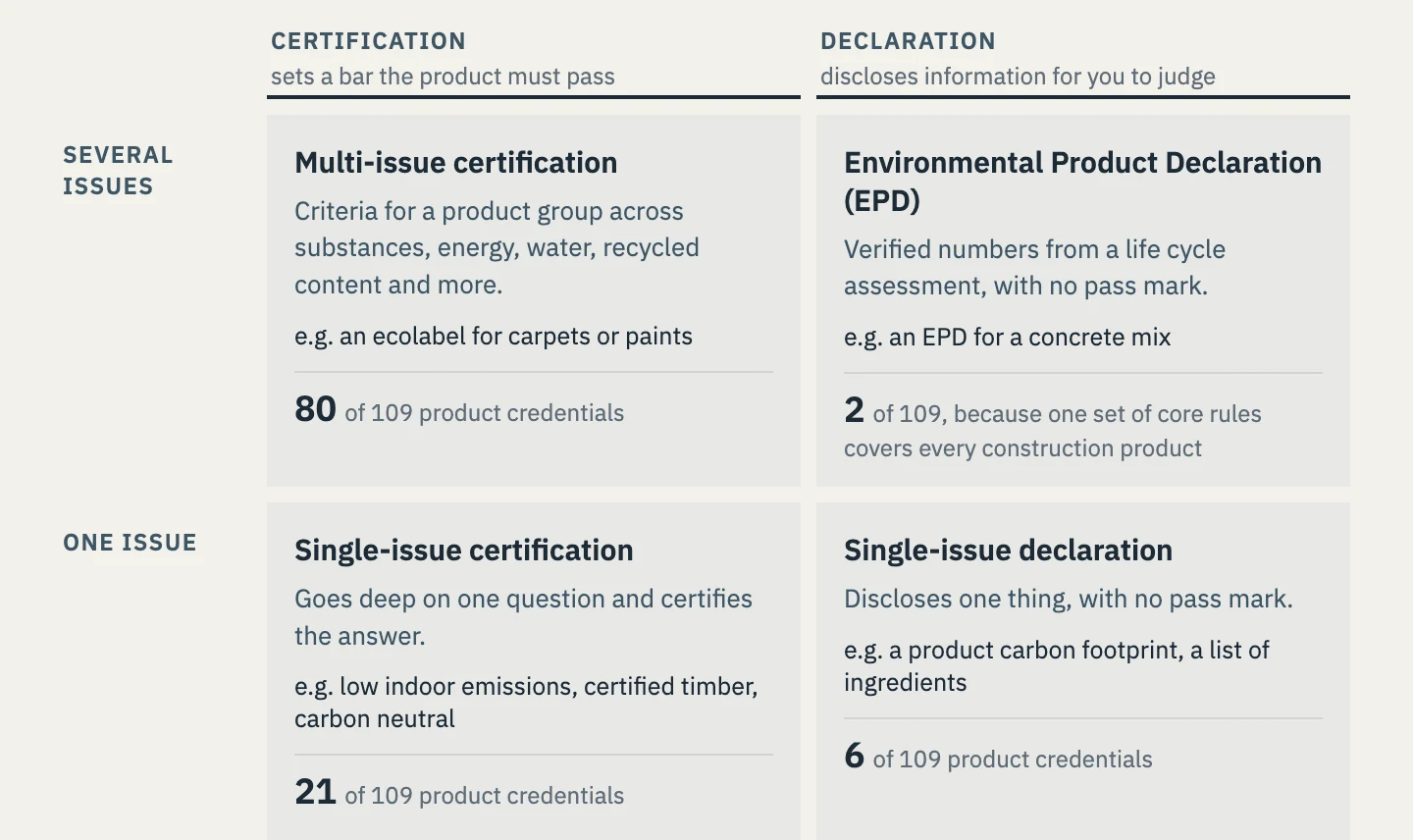
A certification covering several issues
This is what most people picture when they hear "ecolabel". The scheme writes criteria for a product group, such as carpets, paints or furniture, and a product that meets them may carry the logo. The criteria usually reach across several issues at once: harmful substances, energy and water in manufacturing, recycled content, and sometimes working conditions in the factory. The best-known are ecolabels that follow ISO 14024, the international standard that calls them Type I ecolabels.
What you get is a simple yes: this product passed. What you don't get is the detail behind it, unless you read the criteria.
A certification covering one issue
Some certifications go deep on a single question. A low-emission certification tells you a floor covering's emissions into indoor air stayed under set limits in a laboratory test. A chain-of-custody certificate tells you the timber can be traced to certified forests, or to a stated mix of certified, recycled and other checked sources, through every company that owned it. A carbon-neutral certification tells you the emissions were measured and offset, with a plan in place to reduce them.
These are often exactly what a project asks for, because a credit or a specification is usually about one thing at a time. Just don't read more into them than they cover: an indoor-air certificate says nothing about where the wood came from.
A declaration covering several issues: the EPD
An Environmental Product Declaration (EPD) is a report of a product's environmental impacts, calculated by life cycle assessment and checked by an independent verifier. It gives you numbers, most famously the carbon footprint, alongside other impacts such as water use and resource depletion. The international standard calls it a Type III declaration (ISO 14025).
An EPD sets no bar. A product with a high carbon footprint can have a perfectly valid EPD. What it gives you is data prepared to common rules, which is why designers use EPDs to calculate a building's embodied carbon.
A declaration covering one issue
The last kind discloses one thing. A product carbon footprint gives the carbon number without the rest of an EPD. A health declaration lists what is in the product, often screened against lists of chemicals of concern. Like an EPD, these mostly set no pass mark: they tell you what is there and leave the judgement to you.
Who checks?
Almost all of these are checked by someone other than the company making the claim: an independent certification body, the scheme itself, through its own checks and licences, or, for an EPD, an independent verifier. Of the 147 current credentials in the Klar Cite map, only 3 let the company publish without an independent check, and all three are declarations: two health disclosures and one carbon footprint standard. Even there, one of the health disclosures is reviewed by its programme before it is listed.
That is a useful line to draw. A claim a manufacturer makes about its own product, with no scheme behind it ("eco-friendly", "low VOC"), is a different thing again. In the EU, since 27 September 2026, a sustainability label used in selling to consumers has to be based on a certification scheme or set up by a public authority (Directive (EU) 2024/825).
How the map divides up
Some of the 147 credentials in the map apply to processes or sites rather than products. Of the 109 that a construction product can carry, 80 are certifications covering several issues, 21 cover one issue, and 8 are declarations. That says more about how schemes organise their documents than about what you'll see on products. An ecolabel writes separate criteria for each product group, while one set of core EPD rules covers every construction product, with extra rules for some product groups. In each of the 14 product categories the map uses, a product can carry credentials from between 12 and 17 schemes.
Three questions to ask of any label
Next time you see a logo on a data sheet:
- What kind is it? A pass mark or information, several issues or one.
- Who checked it? Someone independent, the scheme itself, or nobody but the manufacturer.
- What does it cover? Which product, and which issues. A certificate for one product range doesn't automatically cover the next one.
Next in the series: what labels look at, from health and climate to circularity, people and nature.
Klar Cite register, build 2026-10-22-0117. "Credential" is one scheme's standard, version and mark. The four kinds are Klar Cite's classification, not the schemes' own words. Textile standards are included. Counts of credentials reflect how schemes split their documents, not how rigorous or how common they are. More detail: Behind the Logo.