A label certifies a product. A rating tool such as Green Star, LEED or WELL rates a whole building. The two meet when a project team chooses products: the rating tool says which labels count towards its credits, and the label becomes the evidence that a product meets them. That link is one reason manufacturers seek labels.
Every rating tool does this differently, but they share a few patterns.
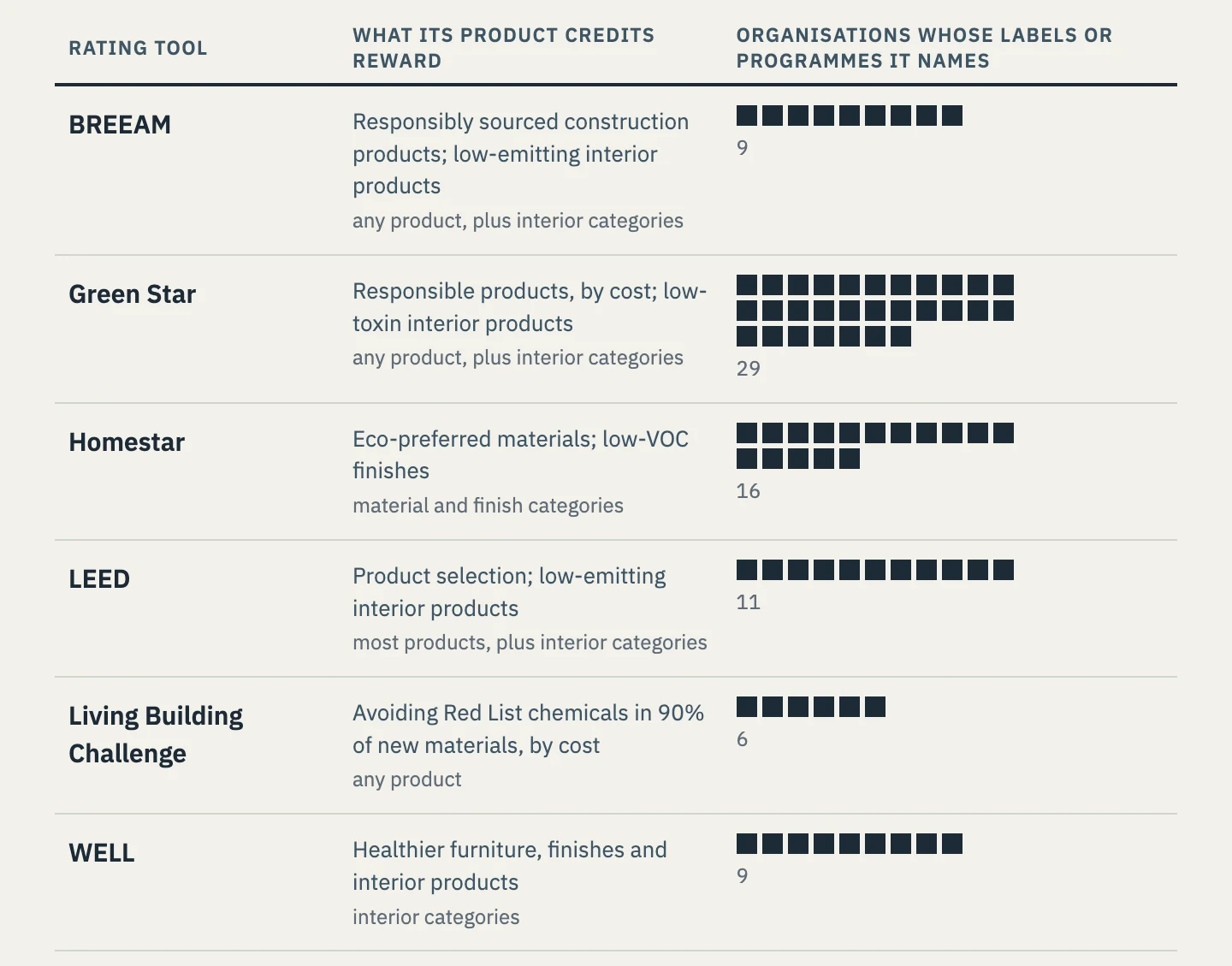
Most run on points
Most rating tools turn a building's performance into points, and the points into a rating, such as stars or a certification level. The Living Building Challenge has no points: a project must meet all of its requirements. Products earn their share of those points through credits: for healthy materials, responsibly sourced materials, lower embodied carbon and so on. Some tools also set minimums that every rated project has to meet. In Green Star Buildings, for example, every rated project must use low-toxin paints, adhesives, sealants, carpets and engineered wood.
The label is how the project team proves that a product meets the credit.
They count a share of the building
Most product credits ask for a share: a share of the products by cost, by area or by volume. A few examples from the tools' own documents:
- Green Star asks for a minimum percentage of products and materials, by cost, to carry labels or declarations that Green Star recognises.
- The Living Building Challenge asks for 90% of a project's new materials, by cost, to avoid a list of harmful chemical classes.
- LEED asks for paints, adhesives, flooring and other interior products to meet its emission criteria, measured by volume, cost or surface area.
- Homestar, in New Zealand, awards a point each for paints, adhesives and floor coverings when 80% of them, by volume or area, meet the VOC limits of a recognised label.
So one certified product rarely decides a credit. What matters is how much of the building it makes up.
Some credits target product categories, others any product
Credits about indoor air usually name the products that matter most for it: paints, adhesives and sealants, flooring, ceilings, engineered wood and, in some tools, furniture. Credits about responsible products, embodied carbon or ingredient disclosure tend to accept any product, from structure to finishes.
That's why a paint manufacturer and a steel manufacturer can face quite different questions from the same rating tool.
Some recognise many labels, others a few
This is where the tools differ most. In the Klar Cite map:
- Green Star's Responsible Products list names labels and declarations from 29 organisations, plus any EPD or product carbon footprint, and gives each a value that reflects how well it aligns with Green Star's guidelines.
- Homestar recognises 16 organisations' eco-labels and indoor air schemes.
- LEED's materials credit names 11.
- The Living Building Challenge names six. For building materials it relies mainly on its own ingredient label, which every project must use for some of its products, and on certified timber. The other four are for cleaning products.
- WELL names nine.
Neither approach is better. A broad list gives project teams and manufacturers more ways to comply. A short list makes it clear exactly what counts, and often reflects a tool with a narrower focus, such as health (WELL) or rules that every project must meet in full (the Living Building Challenge).
Across all of them, 26 of the 30 schemes in the map that certify or declare products are named in at least one rating tool's or procurement policy's list.
Recognition is not a verdict
Being recognised means a rating tool accepts a label as evidence for a credit. It doesn't mean the rating tool has judged the label better than one it doesn't list, and the lists partly reflect where the tool is used and which labels have applied for recognition. The lists also change over time, as tools update their versions and labels apply for recognition.
For a manufacturer, the practical question is which tools your customers' projects use, and which credits your label counts towards in each. For a project team, it is which labels will count, and for what share of the building.
Next in the series: how labels build on each other.
Klar Cite register, build 2026-10-22-0117, rating tools' and policies' recognition lists as recorded, captured from late August to October 2026. Counts of organisations are as recorded in each tool's list and include labels Klar Cite doesn't yet hold. Rating tools rate buildings, and they are kept apart from label counts here.