Labels are often presented as alternatives: this logo or that one. In practice, many of them lean on each other. An ecolabel for furniture may require the wood to come from a certified forest. A building-product label may accept another label's test result as proof. A carbon number in one scheme may have to be calculated by another standard's rules. So when you trust one logo, you are often trusting two or three.
Four ways labels lean on each other
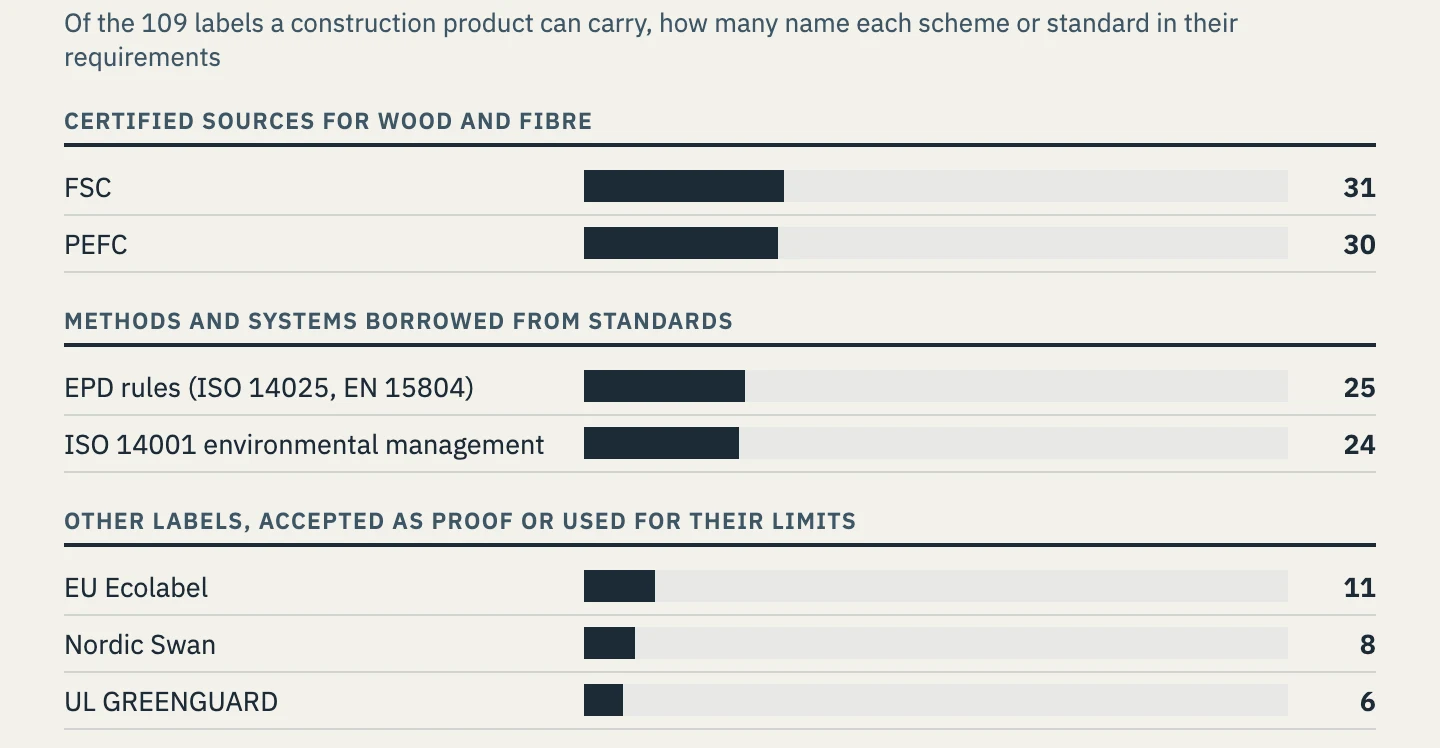
They require a certified source for an input. Of the 109 labels in the Klar Cite map that a construction product can carry, 31 name FSC and 30 name PEFC, the two international forest certification systems, more than name any other scheme or standard. Most of these are rules for wood, paper and fibre in the product or its packaging. An ecolabel for panels can ask for wood from forests someone else has certified, and rely on that certifier's checks of the forest.
They accept another label as proof. A label can also accept a certificate from a scheme that has already run the test. One Australian ecolabel accepts wool from a supply chain that already holds the EU Ecolabel or the Nordic Swan. A New Zealand ecolabel for carpets accepts any one of several indoor-air schemes for emissions. Some labels also accept a recycled-content certificate as proof that a material is recycled.
They use another standard's method. Some labels set a rule but borrow the measuring stick. At least 25 labels in the map refer to EPDs or the rules behind them, for example by requiring an EPD, or by setting a carbon limit that has to be calculated the EPD way. 24 refer to ISO 14001, the international standard for environmental management systems, usually by asking the maker, or its suppliers, to run a management system that follows it or is certified to it.
They share their machinery. Some schemes are connected at the root. PEFC endorses national forest standards, such as Australia's Responsible Wood, so a certificate under one is recognised under the other. One textile standard lets the certification bodies of another issue its certificates.
A closer look: one label that builds on many
Cradle to Cradle Certified is a good example of a label designed to build on others. Its owner keeps a list of certifications from more than 30 other organisations that count towards parts of the standard:
- certified forests, and recycled, organic or compostable materials, including the EU Ecolabel for textiles;
- schemes for palm oil and other farmed materials;
- renewable energy and carbon credit standards for the energy and emissions of making the product;
- fair trade and social certifications for working conditions.
For each of these, it points to schemes that specialise in that check.
Why it matters
For a specifier, a logo can carry more than its own checks. Where a label requires certified timber, the forest standard's rules on land, water and people come with it, a level down, for the wood that is certified. It also means the chain is only as strong as each link, so it's worth knowing which link a claim rests on.
For a manufacturer, evidence can do double duty. A forest certificate, an emissions test or an EPD you already hold may count towards a second or third label. Read each label's wording, though: one may accept the certificate as it stands, while another wants a specific level or a specific test.
For the market, I see this web of links as a quiet strength. Schemes that specialise in one thing, such as forests, fibres or emissions, are reused by many others, which can save cost and avoid repeating the same audit. I think it is also one reason the landscape looks more crowded than it is: many logos share a smaller number of foundations.
That closes the series. If you'd like to see the links for a particular label, or which labels a certificate you hold might count towards, that is what the Klar Cite register lets you trace, clause by clause.
Klar Cite register, build 2026-10-22-0117, counting labels whose current requirements name each scheme or standard. A standard with several marks counts once per mark. The search uses the full wording the register holds, including wording the app doesn't show. A name in a clause is a mention, so the count was read-checked: in a random sample of 30 mentions, 28 were a label accepting, requiring or using the other scheme or standard. Cradle to Cradle's list as recorded from its owner's list of recognised programmes (version 5.0). Textile standards are included. Counts are not a measure of rigour.